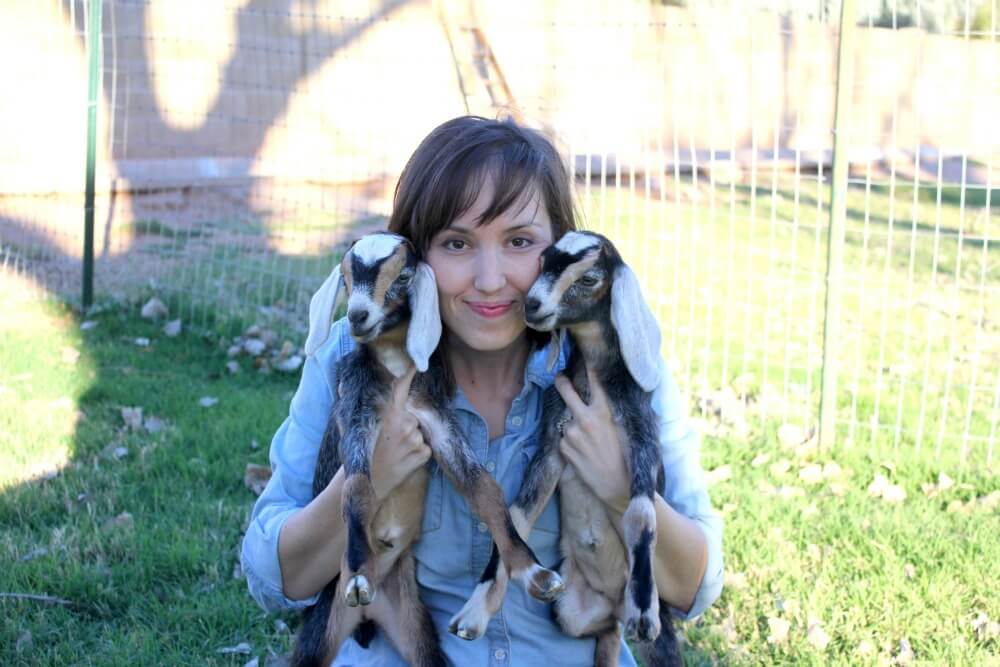
Since I know all you guys are just dying to own some goats…
…and since I know all your husbands/boyfriends/fiances/girlfriends/wives are, like, totally begging you to please move to a farm so you can milk goats every morning… I’ve decided to compile a simple guide to raising and milking goats.
When I first was interested in getting a goat or two, I had NO IDEA how it all worked. Hopefully I can assist some readers out there in their research and maybe I’ll even convince you naysayers to get a goat yourself! Then you can be a weird goat person like me! And just think, next year you can send out Christmas card photos of you and your goat. (Don’t worry, you won’t look weird AT ALL).
The Basics:
Female goats are called DOES or DOELINGS as babies. Male goats are called BUCKS or BUCKLINGS as babies. If a male goat has been castrated (neutered with simple rubber banding) they are known as a WETHER.
The ONLY way to get milk from a goat is to get a female doe pregnant so she can have babies first. Each time a goat has babies, this kick starts her milk production and is known as a FRESHENING. It’s very similar to humans. At first the mother has a lot of milk, but then gradually over the course of about a year, the amount of milk reduces. Typically, goats have their babies in the spring, then at 8 weeks you can sell the babies and enjoy milk for almost an entire year. You’ll want to breed your goat again in the fall if you want to freshen her milk again in the spring. Don’t worry, you can still milk a doe while she is pregnant, but you’ll have to let her dry up 2 months before she is due so she can build up some nutritional reserves for her offspring.
Here’s a pic of a fabulous Nigerian Dwarf goat who looks like she really needs to be milked. Ouch.
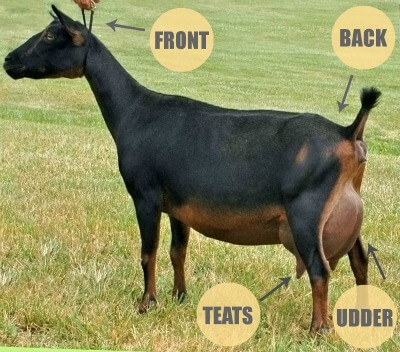
Debunking some Myths:
Goats will not eat your lawn mower, your outdoor furniture, your trampoline, or your kid’s toys. They may chew on the bark of a tree and will eat the fruit that falls off (although my goats don’t like citrus), but that’s about it.
Female goats (or DOES) are not mean and won’t try to head butt you or bite. Male goats that are castrated (WETHERS) are nice too. Male goats that are intact (BUCKS) can be aggressive and bite/head butt. But I’m sure there are some nice ones out there, too. 🙂
Purchasing your very first Goat:
First thing you need to know is that there are many different breeds of goats.
- There are dairy breeds: Nubian, La Mancha, Alpine, Oberhasli, Toggenburg, Saanen, Sable, and Nigerian Dwarf goats.
- There are meat breeds: Spanish, Tennessee, Boer, and Kiko goats.
- There are some fancy–pantsy breeds that produce fibers for fabric: Angora and Cashmere goats.
- And then there are the fun pet breeds: Pygmy and Fainting goats.
I’m sure I forgot a couple breeds here, but you get the idea that there are special jobs for certain breeds. Since I don’t know very much about any other breeds than milking breeds, that’s what I’m going to talk about today. (Although it would be pretty fun to have a couple fainting goats, am I right?)
When I started looking at the different dairy breeds, all I cared about was the flavor of their milk. I tried a couple different breeds’ milk and there were some that had that all too familiar musky/goaty flavor. Yup, not gonna drink that!
When I tried the Nigerian Dwarf’s milk, it was amazing! Very smooth and fresh, and a bit sweet without any sort of aftertaste. I learned that Nigerians were bred for this purpose, to have milk that tastes similar to cow’s milk. So I would personally recommend Nigerians for the best tasting milk. Nigerians are also smaller and eat less hay, so that’s a bonus. Full grown, Nigerians are only about 75 lbs.
UPDATE: I have tried various Nubian milk and some has been delicious. Some was not so delicious. Good milk handling practices are important.
When starting out, you should purchase TWO does or doelings. Goats are herd animals and they will be super sad (and LOUD) if left alone. Ask me how I know.
Yep, we bought just one goat at first and that dang thing was always bleating and calling out for a friend. So you’ll definitely want to find that goat a friend. A dog or some chickens won’t cut it. Any other hoofed animal would though. A cow, a sheep, a horse—they find friends in these creatures too. I wouldn’t recommend purchasing a buck or buckling yet, unless there are not many already close by to breed with in the future. Bucks can stink a lot when they are older, and are pretty disgusting and aggressive. If they are kept in close quarters with a doe, the flavor of your milk can actually taste really bad! They give off strong pheromones that change the female doe’s hormones too. In the end, unless you want to really start a herd of goats, you can just borrow a buck once a year for breeding time (or take your female does over for a visit to Mr. Buck’s house) and be done with it.
The cost of a goat:
OPTION #1 – Buy a baby goat doeling.
The cheapest way is to buy a young doeling, as young as 8 weeks old (that’s the time when they can be weaned from their mother). Goat breeders usually have a lot of babies around the same time and are willing to offer package deals for two or more goats. The only con with this is you’ll have to wait AT LEAST a year to a year and a half before you can breed, then you’ll have to wait 5 months until they have babies and start giving milk. For Nigerian Dwarfs, you can find a young doeling for $150-$300 depending on their parents background, milking star awards, and colorings. Goats with blue eyes usually cost more.
TIP: The most important thing is FRIENDLINESS of the baby goat. You don’t want one that runs away and is afraid of everything. Although this can be sometimes hard to tell because baby goats like to RUN, haha. As long as they will eat from your hand, you’re okay.
OPTION #2 – Buy a junior doeling.
Sometimes you can get lucky and find an older doeling (6 months to 1 year old) and skip ahead a bit. Female does that are older, but haven’t been bred their first time yet are called JUNIOR DOES. Sometimes you can get lucky and have them bred BEFORE you purchase them. This way, you only have to wait 5 months until you have fresh milk. The only con with this is it gets more expensive as they get older, and then you have to tack on a breeding fee. I bought a Nigerian Dwarf goat this way for $400 total. Five months later, she had babies and it was perfect. Although we did pay top dollar at first.
TIP: You’ll want one that is friendly and NOT SKITTISH, and you’ll want to look at HER MOTHER’S TEAT SIZE and production. Don’t even worry about the junior doeling’s teats, they are always small before they have babies, but just be sure to check the mother.
OPTION #3 – Buy a senior doe in milk.
The final way to purchase is to look for a FEMALE DOE ALREADY IN MILK. This is what I tried to do at first. I “thought” this was the easy way, but in the end I just kept getting does that nobody wanted and had problems. Sometimes you can find one that is a good producer and no problems, but more often than not, the breeder is downsizing the herd, and the doe your about to purchase is at the bottom of the list. You’ll find these does are cheaper, like $150-$200.
TIP: If you still want to pursue this option, look for traits that will be worth having. You want a goat that ISN’T SKITTISH, that is producing the correct amount of milk for the season (see below), and that has a good teat length (1 1/2 inch or longer). You’ll also want to make sure she doesn’t have any visible signs of infection or skin disorders.
The Cost to Keep a Goat:
Nigerians eat 2 lb. of feed a day, which is 4 c. of the alfalfa/bermuda blend pellets. We have figured that it costs us about $12 a month in hay/pellets to feed one Nigerian Dwarf goat. If they are giving 7-15 gallons a month of milk, then it comes out to an average of $1.50/gallon of milk. This is assuming your only costs are the basics though. You need to add on the costs for minerals, herbs, wipes, filters, and the occasional Ultrasound ($20) or blood test ($5-$25).
How much milk does a goat produce?
When a Nigerian Dwarf FRESHENS, or has babies, her udder is operating a full capacity. You will start to milk your goat when the babies are two weeks old. You will separate the babies from mom at night and then let her udder fill up all night. In the morning she will have a large udder full of milk, and you can milk as much out as you can before letting her back in with her babies for the rest of the day.
But what about milk for the babies? This is the awesome thing about goats. They have a reflex that will literally “hold back” milk for their babies. So, in the morning, when you are milking, you can simply milk until she wants you to stop. You will know because you will squeeze and squeeze and barely get anything. Pretty cool, huh? I think so!
Once the babies can be weaned (8 weeks old) you will be able to milk your goat morning and night. This is when your goat will be at her PEAK PRODUCTION. At this time our Nigerian Dwarfs are making about a quart or more at MORNING and again at NIGHT. Total milk per day is 1/2 gallon or 15 gallons a month.
Very gradually, your goat’s milk production will start to go down. At about 5-6 months after freshening, a Nigerian Dwarf will give about 3 cups at MORNING and again at NIGHT. Total milk per day is 1 1/2 quarts, or 11 gallons a month.
At about 8-9 months after freshening, she’ll be at 2 cups at MORNING and again at NIGHT. Total milk per day is one quart or 7 gallons a month.
If your doe is pregnant, then her milk will continue to dry up and at 10 months you should stop milking. If your doe is not pregnant, she may continue to produce milk for up to 2 years. It really just depends on the individual goat.
Raising baby goats:
A baby goat must drink from its mother for at least 8 weeks before it can be weaned to complete hay or pasture. Some goat owners will take the babies away from the mother right away and bottle feed. They will keep them in separate places, milk the mother, and then pour the milk into a bottle and feed the baby. Seems like a lot of work, huh? Well, some goat owners believe this is beneficial and makes very tame and friendly goats. In an extreme case where the goat momma dies or abandons her kid, you’ll be stuck with this task whether you want it or not.
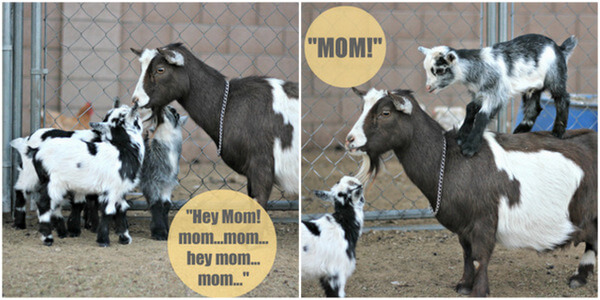
It’s really quite a sweet thing to see a momma goat patiently feed her hungry babies, call out when they call for her, and endure the endless jumping and tugging on her body. As a mom, I totally understand what she goes through. And by the time they are 8 weeks old, they are naughty teenagers ready to explore on their own!
What do goats eat?
Contrary to popular belief, goats don’t eat everything. In fact, they are picky little stinkers! Goats are browsers, not grazers. This means they do not like to graze like a horse or cow or deer. They like to forage for their food and tend to love weeds more than grass.
In my area, we have alfalfa hay bales, bermuda hay bales, and a bermuda/alfalfa blend. We also have alfalfa pellets, bermuda pellets, and bermuda/alfalfa pellets. Goats can eat different things like rye, clover, fescue, and orchardgrass. Since I live in the desert, we pretty much stick to alfalfa and bermuda with some occasional clover.
Here are the PROS and CONS with buying goat food in HAY vs. PELLETS:
HAY (alfalfa, bermuda, or blend)
PRO: Hay is in the best for a goat’s stomach. The long stems aid in digestion and bacteria processing done in their rumen. Anything in its most natural form is going to be the healthiest.
CON: It’s usually a couple dollars more expensive. It’s messy. And since goats are foragers, they will sift through it, eat the best parts, and leave a lot of waste. Don’t think that if you stop feeding them, they’ll eat the waste eventually, because they won’t. They are stubborn and will starve before they eat it. Okay maybe not starve, but they’ll get pretty malnourished.
PELLETS (alfalfa, bermuda, or blend)
PRO: It’s a couple dollars cheaper than hay. It’s clean and easy to transport and carry. There’s no waste. The alfalfa/bermuda is washed with water before processing. This is especially beneficial if you aren’t able to purchase organic varieties. Hopefully during the washing, some of the pesticides can be removed.
CON: They tend to bloat more with it. Goats do need those long stems and you’ll want to try to supplement a bit with a real hay or grass substitute if possible.
You can read my article here on how we feed our goats (from hay to grain to supplements)
Breeding a goat:
If you don’t own a male goat (also known as a BUCK), then you’ll need to find one if you want milk. The cost of a stud fee can vary greatly depending on the quality of the buck. I would say it’s anywhere between $50-$100 for a breeding. We’ve brought our female does to the buck’s house, and brought the buck to us. Both ways work, so it’s up to you on which you prefer.
But it’s not very fun to transport a buck, let me tell you! If you are paying for a stud fee, the buck owner should take responsibility of checking frequently to notice if your doe has been bred. Sometimes it can be easy to miss, but they should be making an effort. A good sign that your doe has been bred is that you’ll see a milky white discharge coming from her. Sounds gross, I know. But it’s really hard to tell if a doe is pregnant until they’re about to deliver (they have such big stomachs anyway), so be very grateful if you see that fluid after a breeding!!
Caring for a pregnant doe:
A goat pregnancy lasts 150 days, or 5 months. You can milk a pregnant doe until 2 months before delivery. They naturally start to dry up at this exact same time anyway, but it’s important to encourage it to happen. To dry up a goat, you simply milk less. You can go from every other day, to every few days, and by then you won’t want to drink the milk. By this time the mineral buildup is too high and the milk will taste salty.
Make sure in the last two months you de-worm them herbally and supplement their diet with some leftover produce scraps from your kitchen. Fruit and vegetables can be fun treats at this time and give a little boost of nutrition. You can also give a little organic grain as a treat, but don’t overdo it. Traditionally, animals ate a leftover grain from the harvest in the fall, but grain is hard to digest and can be acidic to a goats body. Some people believe animals with rumen stomachs shouldn’t eat grain at all, but I think a little now and then is fine. I will also soak the grain or sprout before I give it, to help with digestibility.
A telltale sign that your doe is getting close to delivery is to run your fingers alongside her spine all the way to the tail. Just before you get to the tail, see if you can squeeze the ligament just before her tail. If you do this about 2-3 weeks before delivery, you’ll be able to notice a definite relaxing of that ligament. Once you feel it’s completely gone, you know delivery should be soon, within a couple days.
To spare you all the details of birth, go ahead and visit the Fiasco Farms page about goat deliveries. And be sure to prepare yourself for the occasional problem delivery. We went 4 years with no issues and then we had an issue with this goat delivery here. Read up on possible issues during delivery before it happens! Don’t worry, there aren’t a ton of issues that can happen, but there are a couple things you gotta understand about how baby goaties are born.
Baby goaties are here!
Yes, I know they’re called kids. Over here we like to say baby goaties, ’cause we’re cool like that. When the goaties come out, be sure to wipe them off and sit them right up to Mom so she can lick ’em till they shine 🙂 You don’t want to take them away and clean them or anything, because you want the mom and baby bond to develop! The surge of oxytocin she gets will help her feel that love towards her little goatie. And trust me, you want a momma goat that loves her baby!
It won’t be too long until that baby starts to stand. You’ll want to stay out there with Momma and babies until you are sure all are standing and able to suck. Sometimes you’ll get a weak baby and you’ll have to watch for that. You’ll probably walk out to check on them/play with them in the next couple days anyway, so just take note while you’re out there and make sure each kid is able and strong enough to fight its way to a teat.
The DAM (or momma doe) will have afterbirth/blood/goo for up to 2 weeks. As long as it gets less and less, she is fine. You may take her temperature to monitor her health, but I never do this because I know my goats behavior pretty well and if they are eating and drinking and alert I know they are okay.
How to actually milk a goat:
Once upon a time there was a woman who bought a goat. She was so excited to get FRESH milk every day! She woke up early one morning, and with butterflies in her stomach she put her goat on the milking stand, poured some grain in the feeder, and started to tug. Nothing. “Hmmmm,” the woman thought. She tugged and tugged. After 30 minutes and approximately one teaspoon of milk, the woman started to cry. “Why can’t I milk this freaking goat?!”, she yelled to the sky.
Then the woman got the BEST idea! She raced inside and rummaged through some old boxes. She ran back out to the impatient goat. Using her old breast pump, the woman was able to extract all the milk from the goat.
Aaaaannd THAT is how my first experience with milking a goat went. Yessiree, I used my old breast pump. Worked well, too! Only thing was, I knew I’d eventually have to learn how to milk my goat the right way.
Here’s what you do: You don’t tug at all. Your goal is to trap the milk in the teat. You do this by pinching your thumb and first finger. Then WHILE HOLDING THAT PART PINCHED, you put pressure on the teat with your other fingers.
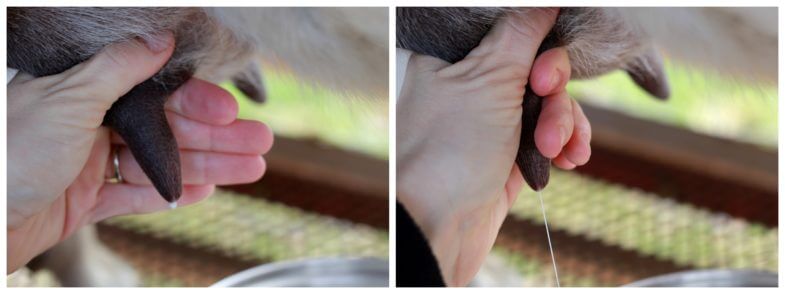
It’s more difficult than it looks. But this is only because the muscles in your hands aren’t strong yet. At first it’ll take you 30 minutes to milk a goat, but then you’ll get to the point that it literally takes you 5 minutes. Trust me, you’ll get so fast at milking and your brain will memorize the movement that you’ll be able to do it in your sleep.
Watch my daughter teach you how to milk a goat!
How time consuming is it to raise and milk goats? And how do you take vacations?
It would seem from all this information that it must take A LOT of TIME to keep goats. But actually, I probably spend 10-25 minutes a day taking care of them. This includes feeding AND milking. When they go into labor, I spend probably 3-4 hours with them, but that’s only once a year.
When we want to go on vacation we call up a fellow goat friend and do a trade. We probably go on vacation 2-3 times per year so it’s no big deal. I actually enjoy milking my friend’s goats for a week or so because I used the extra milk to make a lot of cheese! The best way to find goaty friends near you is to join the American Goat Society. They have a directory of all the breeders in the U.S., which they will mail to you!
“WHEW!”
Holy long blog post, Goat Girl! I think I just about covered everything I can think of. Peace out goat lovers!
Hello, I am looking to purchase my first ever goats. My family really doesn’t like goat milk but we want some that are good pets and that will also eat our weeds. Do you have any breed recommendations? Or would it be a good idea for us to get two wethers? Hopefully you see this! Thank you!
Hi Danielle-
Wethers do make nice pets. Does do as well and you don’t have to breed them or milk them if you do not want the milk.
This article can help you with information on different breeds so you can find the right one for you: https://www.weedemandreap.com/choosing-goat-breed/
Thank you -Bobbi (DaNelle’s Assistant)
Hi there! I am a bit confused about grain. Is there grain in goat feed pellets? Are some goat feed pellets just compressed hay and others a mixture of hay and grain? What kind of grain are you referring to when you say you offer grain to your does that are producing milk? Sweet feed? Just straight up oats? Thanks!
Hi Jodie-
This is how DaNelle feeds her goats: https://www.weedemandreap.com/optimal-nutritional-goat-diet/
Links to the grain she uses can be found on her Resources page: https://www.weedemandreap.com/resources/
and also on her Amazon page: https://www.amazon.com/shop/weedemreap?listId=3K0J0CWBA8ESS
Thank you -Bobbi (DaNelle’s Assistant)
Cow and horses graze. Deer are browsers like goats. Enjoyed the article.
What fencing do you use and where do you get it? Is it cheap? I can’t find any good fencing that’s on the cheaper side ?? please help!!
Hi Lyla-
This article talks about goat fencing: https://www.weedemandreap.com/goat-fencing-breaking-out/
Most fencing comes from the local farm stores.
Thank you -Bobbi (DaNelle’s Assistant)
We have 5 goats… 2 5 month old doelings but one was stunted with codicidia 1 2 month old doeling 1 2 month old wether and the young kids mom.
They are nds and the mom comes from sunnydale farm Hope lines ( their best Milker) but it is her first freshening and she is horrible on the stand and only give about 1/8 a cup of milk. Thx
Cate
Have you tried a milking machine? That might get more milk out of the doe.
If she never been milk before then you just need to give her time and she will get better. I won’t give her more then a cup of grain on the stand unless hers really a heavy milker. If you are milking and the milk stop coming out you have muff the udder to get the milk down like what the kids do when they milk and they “hit” the udder. ( it look painful when the babies do it) Hope that helps.
I love this blog. I have referred to it many times. I am new to goats, almost a year in now. I have recently started milking my alpine. I clean her udders, rinse, and wipe with a towel. Milk her, and I get floaters (hair and other small debris). I take it directly in the house, strain it with a wire strainer, and an addition filter, but I am still getting small small floaters. Is this still safe to drink? BTW I have never tried goats milk and now seeing the floaters makes me not want too…help?!
Hi Samantha-
You may need a different filtering system if the hair and dirt are not being removed. What DaNelle uses for a strainer and filters can be found on her Resources page: https://www.weedemandreap.com/resources/
Thank you -Bobbi (DaNelle’s Assistant)
Great blog! Question- I have a Nigerian dwarf goat. We are going on vacation for a week and I cannot find anyone with milking experience to milk her. She is still nursing 2 doelings (that are almost 5 months old). I usually separate them at night, but occasionally I’ll leave them together..when I do leave them together, they completely empty her. Will she be okay if I leave her for a week? Will she maintain milk production?
Thank you!
Hi Jessica-
If the kids are nursing from her then she will retain milk production.
Thank you -Bobbi (DaNelle’s Assistant)
Hi I learned so much from your blog as well as your YouTube channel. I live in the city and recently started a homestead with two goats. Our 1/2 Oberhasli 1/2 Nigerian Dwarf doe in milk kidded just under two months ago. We started milking her and got less milk than we were hoping for/thought we would get. Can we milk her 3 times a day? Will it produce more if we do so? Is it unhealthy for the doe?
Thank you!
Hi Leah-
I would not milk her more than twice a day. This can be stressful and will not supply you with much additional milk.
To increase her milk production make sure she has plenty of fresh water and her nutrition is up to par. https://www.weedemandreap.com/optimal-nutritional-goat-diet/
Also you may want try Mo’ Milk by Molly’s Herbals: https://fiascofarm.com/herbs/mollysherbals.php/products/momilk
Thank you -Bobbi (DaNelle’s Assistant)
your pictures showing your love for goats. your article showing your passion in goat farming. i love your blog.
Happy Goat Farming!
Have really enjoyed a number of your blogs! You always present the information so clearly! I am wanting to get into milking the Nigerian Does we have and am having a hard time finding clear recommendations for milk testing. Did you test your milk for the diseases that can transfer–prior to milking them?
Thanks!
Hi Ashley-
Here is an article DaNelle wrote that mentions that testing is important for the diseases she notes in this article: https://www.weedemandreap.com/drinking-raw-milk/
If you want to test your milk you can do that. It would be best to contact your local county extension office and they can tell you who in your area offers milk testing services.
Thank you -Bobbi (DaNelle’s Assistant)
Hi DaNelle,
My kiddos (2 legged) and I enjoy watching your YouTube videos. We also have goats but they are a meat breed. We are considering getting a dairy goat for some fresh milk. I was wondering what you do for udder care before/after you milk. I know some people use teat dips etc. Do you use anything like this? What is your routine in the milking stand? Thanks for the help and the info!
Hi Meagan-
DaNelle uses udder wipes and udder balm, and also uses a teat dip. You can find info on all those here:
https://www.weedemandreap.com/homemade-udder-teat-wipes-milking/
https://www.weedemandreap.com/homemade-udder-balm-recipe/
https://www.weedemandreap.com/goat-supplies-raising-milking-kidding/
This link is to DaNelle’s video about mastitis. Start watching at about minute 8 and you can see how she dealt with it naturally.
https://m.youtube.com/watch?v=Vw9AWLGU8W4
Also the article linked in the video comments can be found here: https://fiascofarm.com/goats/mastitis.htm
I hope that helps. Best of luck.
Thank you -Bobbi (DaNelle’s Assistant)
My mom had goats for a while and it was so fun but also a hand full. She bought them all in the early fall and then they all had babies in January and it was so cold out and she had to try to figure out how to keep the babies warm enough. Then later in the spring there was a bout of foot and mouth disease! ugh. But those were the cutest babies and we still remember it fondly!
if you go on Fias co Farm Goats as pets there is some information. we have five goat sat hom and we have 1 billy goat he breed four goats now we have 4 goats that are going to have a baby
Holy cow that is a lot of information to take in. I currently feed a grain in the morning. What I am hearing is that they really don’t need this? I thought they had to have the grain for a well rounded diet. I would love to take them off of this if I could.
Hi Renee-
No, goats do not need grain, in fact too much can cause rumen upset. This article talks about how DaNelle feeds her goats including supplements and minerals. https://www.weedemandreap.com/optimal-nutritional-goat-diet/
I hope that helps!
Thank you -Bobbi (DaNelle’s Assistant)
How do u treat them herbally?
Also what is the sprouted barley process? Step by step?
Hi Tate-
These articles will give you info on herbal treatment and sprouting barley:
https://www.weedemandreap.com/herbal-healthcare-for-animals/
https://www.weedemandreap.com/guide-soaking-sprouting-grains/
Thank you -Bobbi (DaNelle’s Assistant)
WOW. This was soooo helpful and you made it very easy to understand. thank you so much for this article.
Oops disregard that as I see you did source the owner. They have great lines there and am lucky to own a few from them.
Hello,
I am from Yemen. I have got two local goats. The problem is before giving birth the pregnant female produce milk in normal amount, after it gives birth the milk production reduced to get nearly 80%. Can you help me identify this problem. just know that goat age is 6 years .
I appreciate you help.
HiBadiea-
A doe’s milk production can drop off for several reasons. First off, if she has kidded the babies are now taking some of her milk and you will get less when you first start milking her, but this will increase over time. You should not milk your doe for the first 2 weeks after birth so the babies can receive all of the colostrum and it doesn’t stress your doe out too much. Also, a few weeks before she gives birth you should stop milking her.
A doe’s milk can also drop if she is not receiving the proper nutrition. She needs high quality forage with adequate protein. To maintain good milk production, she needs to eat at least 5% of her body each day. Here is how to feed your goats: https://www.weedemandreap.com/what-do-goats-eat/
Your doe will also need the proper supplements and mineral:
https://www.weedemandreap.com/supplements-for-goats/
https://www.weedemandreap.com/goats-minerals-what-you-need-to-know/
Another issue that can case decreased milk production is if your doe is overrun by parasites. You need to be sure to properly and consistently deworm your goat. Here is a natural method to try: https://www.weedemandreap.com/natural-goat-dewormer/
I hope that helps and your doe starts producing lots of milk!
Thank you
-Bobbi (DaNelle’s Assistant)
That picture of the Black and Tan doe is Flat Rocks Here For The Party owned by dragonfly farm. Might wanna credit the owner of the picture.
I cannot express how incredibly helpful this was!!!!! Thank you so much for taking your time to write this as someone looking to get goats this has just stormed my brain with so many answered questions I had lingering! Thank you!!!!!
Hello! I have a question on selling kids. I know that with sheep if there are multiple births and the babies were raised together they must be sold together or they will become depressed and could even die from the depression. Is this the same with goats? If I am selling my baby does do they have to both go to the same new owner or could they be sold separately?
Hi Krista-
I have sold my sibling kids separately and they were just fine. Goats do need to be with other goats (never a good idea to have one by itself), but they don’t have to be related.
Thank you -Bobbi (DaNelle’s Assistant)
Is there any specific care instructions for the Umbilical cord?
For the umbilical cord: just trim it if needed and apply some betadine solution to the end of the umbilical cord.
You can learn all about postpartum care for mama and baby here: https://www.weedemandreap.com/post-partum-care-goats/
Thank you -Bobbi (DaNelle’s Assistant)
I love the video with Beth Miller, I cant wait for my girls first freshening❤ with that being said I’ll need a milking stand and I LOVE the one she is using and the one yall use, any suggestions on where I could get one similar?
Hi Kacie-
DaNelle had someone weld her stanchion for her. You can find a local welder, or you can build your own wooden one using the instructions from this free download: https://www.amazon.com/Building-Milking-Stand-Foxhole-Homestead-ebook/dp/B006LNUM30/ref=as_li_ss_tl?ie=UTF8&qid=1470700000&sr=8-1&keywords=milking+stand&linkCode=sl1&tag=resourcesweedreap-20&linkId=cc204d8d28e92fbb08d1b6234eff8181
There is also a link in this article to instructions on building a PVC stand: https://www.weedemandreap.com/goat-milking-supplies/
I hope that helps! Best of luck with your first time fresheners!
Thank you -Bobbi (DaNelle’s Assistant)
Hi-Thanks for your blog! I have a question regarding milking. Do kids need to be separated from their dam and weaned to continue milking the dam once per day? I pen kids at night and milk 1x in the morning. Last year, I allowed my dam to wean “whenever” and milked long as she allowed, which wasn’t long after she weaned her kids. She weaned me, too! I really don’t wish to separate my 10 goats into smaller herds. They aren’t in pens and free-range on pasture. Thanks for any advice!
Hi Deb-
If you want to milk your doe you will need to keep her kids separated from her at night if you want to milk in the morning. After you wean the kids from her, you can continue milking her until you breed her again and she’s a couple months away from delivering. I hope that helps! Best of luck and Happy Milking!
Thank you -Bobbi (DaNelle’s Assistant)
I have two nubian does , 1 buck and 1 wither (his son by my doe) This is their second year of milking. One doe had quads and they did not survive. the other had 2 does 2 days ago.
I have been milking the doe who lost her babies. Up till now she had been a patient milker. Now, she is not. After a little milking =, maybe a quart, she starts putting foot in bucket, bucking, etc.
My question, could I be milking her too much. She was giving 6+, then 7+ and today 8+ lbs of milk. One milking only per day-morning/ Could she be getting fussy because I am milking too much. Should I cut back and take less milk?/
I have not updated my web page but here are the stats – lamQUINNNUBIANS.COM. This doe is “Chikelu”
Hi Catherine-
I don’t think you are milking her too much. However, she may be sore from an infection or injury or is not feeling well due to something else. Check her temperature, feel her teats and bag to se if they feel hot or you feel a lump, and make sure when she goes to the bathroom it looks ok. Also, be sure that she has be wormed appropriately. If she continues to not to give milk and/or shows signs of other illness, I would check with the vet.
Thank you -Bobbi (DaNelle’s Assistant)
Great article! Thank you so much for taking the time to put so much information together for people. I am about to get my first milking goat. Going with your option three, a little 3.5 year old Saanen doe who has her 6 month old wether coming with her. Your article is going to be invaluable!
Hi Doris-
So excited you are getting goats! Best of luck and Happy Goating! Thank you for reading and posting. Bobbi (DaNelle’s Assistant)
Hi!
We live in town and are allowed to have up to 3 mini goats. We would like to have goats milk. What are the best kind? We have about 1/5 an acre….will that work? thank you!!
Hi Lacey-
For your situation I think Nigerian Dwarfs would work well for you. They are mini and produce a nice quantity and flavor of milk and have good personalities. And yes, 1/5 acre will work.
Here are some additional articles just for more info on breeds and space:
https://www.weedemandreap.com/buying-your-first-goat/
https://www.weedemandreap.com/choosing-goat-breed/
https://www.weedemandreap.com/how-much-space-need-raise-goats/
I hope that helps! Happy Goating! Thank you -Bobbi (DaNelle’s Assistant)
Hello!
Great article.
I raised Boer goats for years in 4H as a kid, but I recently decided to jump into dairy goats because I love goats milk everything!! I know I have big dreams and I’ll have a reality check later.
So I lucked into a mature doe that’s been bred for my first addition (she is fairly close to kidding – a month or two away) and I was curious about finding a friend for her so close to her due date. I don’t want to introduce a strange goat on her when she will be vulnerable with her kids, but I also don’t want her to be lonely.
SOS.
Thank you!
Hi Moriah-
Ah, yes 4-H is such a great program! So many years involved in it! And goats’ milk is amazing!
You are correct, goats do hate being lonely and prefer at least one other goat around. If she still has a month or more to go before she kids, getting a goat now would be beneficial for her. If it’s a week or less it may just stress her out more. So if you can find a friend now, I think she’d like that. I hope that helps. Best of luck and Happy Goating! Thank you-Bobbi (DaNelle’s Assistant)
HI, I was just wondering if its okay to skip a day or two of milking? I didn’t know if it would effect the goat in any way.
Hi Madison-
If you skip days of milking this will lead to reduced milk production. Also, if you do not have kids nursing the does you need to make sure her udder is ok and doesn’t become infected. I hope this helps! Thanks -Bobbi (DaNelle’s Assistant)
Why do we wait two weeks to milk the goat? Is the milk not safe to drink before that?
Hi Amy-
The milk is safe to drink, but we want to allow the babies those first two weeks to nurse, to get the colostrum and set up a nursing schedule. You wouldn’t want to separate the babies and momma overnight before that time. This is healthier and less stressful for all of them. I hope this helps! Thank you -Bobbi (DaNelle’s Assistant)
HI DaNelle, I have a question for you. I bred my 1 1/2 year old Nigerian dwarf ad she’s end of February or beginning of March. If her udder is filling up now how long do I have until the kids are born.? Thanks:)
Hi Caitlyn-
A does’ udder typically starts filing around 4-6 weeks prior to birthing, with first time does closer to 4 weeks. I hope that helps! Best of luck and Happy Goating! -Bobbi (DaNelle’s Assistant)
Hello! I LOVE your blog! I have been dreaming of owning goats for a while, and am wondering if my situation would be plausible…I apologize if this has already been asked and answered! We live in the city, but have a little farm house about 90 miles away. The previous owners had livestock, so there are several pins, pastures, barn structures on the property, all in excellent condition. I want to start with a small herd, 2-3 does and/or a wether.. Not necessarily interested in breeding or milking—yet…but my question is that can we have goats if we are only out there on the property on the weekends? If they have a pond and PLENTY of pasture, do they need to be checked in daily? I hate to sound naive!
Thanks!
Mindy
Hi Mindy-
People do run goat herds (and other livestock) on multiple acres of land, and no they do not check them everyday, although they do typically check them several times throughout the week. However, that said, if your goat becomes ill or hurt and you only check them once a week they are more likely to end up severely sick, maimed, or possibly die. Plus, if your area has wintertime, the water can become frozen and food can become inaccessible. And the same is true with the summer. If your area experiences severe heat and goats for any reason cannot get to water they will die. Also know that if you are only spending the weekends with your goats they will not be overly friendly with you.
So yes, it can be done, but if you are asking if it is a wise choice, then my personal answer and opinion is no. I hope this helps. Thanks for reading and posting! -Bobbi (DaNelle’s Assistant)
Hello! Do you have any tips on where to buy milk and cheese from goats (or cows) where the babies aren’t taken from their mothers, and only the excess milk is used commercially? I’m assuming it would be expensive, but I’d be looking to get some occasionally as a treat, so expensive is OK. I’ve mostly stopped eating dairy because of the issue of separating the babies and mothers, but I love milk, especially fresh goat milk! I live in Massachusetts. Any leads would be appreciated.
Hi Dana-
The best I can recommend is to contact your local county extension agent to get some names of local producers and then get to know them personally to see how they raise their livestock. You might also try looking online for raw milk producers in your state. I know where I live there is a CSA website and FB page that gives contact info for those that sell raw milk. You can contact them and get to know them and all about their operation. The key is to really know your producer and make that connection. If anyone is from the Massachusetts area and can help out, give us a heads up! Best of luck and let us know if you find someone. -Bobbi (DaNelle’s Assistant)
Hello!
Thank you for the amazing post! I’ve already sent to my respective other as we dream of goats one day, this is so informative.
I was just wondering about the cost of feeding them, I think you might have a typo … on my screen it says 4c/day, but that works out at $1.20 per month, rather than $12 per month.
If it’s $12 month that’s 40c/day … I think? If I’ve mathed correctly? Or it could just be my screen.
Just wondering which way around it is out of curiosity. Thank you so much again!
Hi Ele-
I hope your goat dreams come true! 🙂
As for the cost, the 4c.= 2 lbs. which is ~60 lbs. a month. I am not sure what feed item you were pricing at as I didn’t see the full price of the alfalfa/bermuda blend pellets listed in this article (but I could have missed it). I do know that in DaNelle’s other article: https://www.weedemandreap.com/what-do-goats-eat/ she mentions Chaffhaye, which is ~$12 for a 50lb bag. So even just looking at that price it would be over $12/month to feed one goat.
I hope that helps. Thank you for reading and commenting! -Bobbi (DaNelle’s Assistant)
Thank you for the wonderful info! We are 1st time owners and just got 2 goaties. 1 buck and 1 doe. they are going on 6 weeks and we are bottle feeding with moms milk. The mom’s milk is available to us as long as we need her milk. My question is how do we wean them? We would like to start the process so they are weaned by 8 weeks. Right now they are still on milk but have alfalfa hay to nibble on (which they do). I have alfalfa pellets, MannaPro calf manna, MannaPro goat mineral powder, and baking soda. When, how, and how much, do we feed as we wean? I guess I’m looking for some kind of weaning schedule or process to follow. We are getting him wethered hopefully this week because he is already extending and VERY bucky. I live in New River AZ and am VERY interested in learning everything I can about growing our own hay as well. I have 5 acres. ANY info on the weaning part would be GREATLY appreciated. I’d be happy to send my email or phone # if anyone would be willing to chat & educate me!! 🙂 Thank you!!! Emily
Hi Emily-
So exciting you have little ones! For weaning bottle kids it’s best to start introducing solid food, like you mentioned, anywhere between 3-5 weeks and continue to do so until the weaning process is complete, and then after so that they obviously have something to eat if they aren’t turned out to pasture at that time. As for weaning, I usually keep bottle feeding my babies for 3 months. They do decrease the amount of milk they drink on their own as they consume more solid food, but I find milk in necessary for proper growth until then. Often does will feed kids up to 6 months. As far as a weaning schedule, it really depends on your kid. If I find a kid has a low rate of gain then I keep him on 2 bottles until the 3 (sometimes 3.5) month mark. If I got a stout little one, I began reducing it down to 1 bottle a day around 2.5 months. When that ~3 month deadline comes up, I go cold turkey on most of them. It usually isn’t too bad because by 3 months they are good at eating solid food and don’t miss the milk as much. What they will miss is your time with them that were getting when you were bottle feeding them. So cut them off of the milk, but not the attention and affection. Soon they will adjust and forgot all about the milk. Just watch them pretty closely when you wean to make sure they are still gaining weight and don’t exhibit any signs of illness. I hope this helps! Happy Goating!
Can you please share more about your herbal dewormer process and what products you use?
Thanks!
Dear Danelle
Can you please suggest me what type of goat i can farm to get max milk considering the weather and climate of our country. thanks in advance
Hi! Maybe this post might help?
https://www.weedemandreap.com/choosing-goat-breed/
Hi!
So, I have a mama almost ready to give birth! I think! I have never done this before! How do I grow the barley etc for when I am milking her? Do you have a good website to send me to? Can you email me the response?
Hi! Here is a link to my posts about goat births. I hope it helps!
https://www.weedemandreap.com/?s=goat+birth
Hi DaNelle,
I was wondering if you have any tips on training a Dam to relax and be still during milking? We purchased a Dam and her doeling. This os her first freshening and she has barely been hand milked, maybe twice, though she is fine getting up on the stand, she just hates having her teats touched. She squirms and kicks. I know to use the hobbler restraints, but I would love for her to calm down and feel safe. Is it possible her teats are sore or in pain to make her react this way?
Hi Stefanie,
For these goats, you need to focus on keeping your hands on her teats no matter how much she kicks. Eventually, she will learn. On average it will take about 3-4 months of consistently (not moving your hands) until she realizes you’re milking no matter what and she gives in:)
You seem to care about doing what’s natural for the goats based on your opinion of how long goats should stay with their mother, but I wonder why this whole idea of keeping an animal confined to your backyard so that you can take the milk intended for it’s young isn’t questioned. What are your opinions on this?
It is questioned, especially by people that don’t drink milk. We don’t take the babies away from mother and so what she intends for her offspring is always received by them. We do, however, take the excess and when she weans her babies, we take over. And as far as confinement, one goat requires a minimal 250 sq. feet, but we give ours over 43,000 square feet and we feel great about having a large pasture rich with their favorite plants and trees. After being vegan ourselves for a couple years, we decided that if we were going to drink milk, we needed to do it ourselves instead of purchase from large dairy farms where we couldn’t trust if their practices were ethical.
Great Response and VERY responsible of you:) Kudos!
Hi, As I was reading,you kept saying about the Nigerian Dwarf in lots of the post,well I love that breed but I think the La Mancha are the best,did you know that a doe can be milked 2 years in a row without being bred,I just got one and she is a bottle baby and so sweet,you should try one
Hi
We have a buck and a doeling that gave birth to two bucks four days ago. Is it ok if we have 3 bucks and one doeling.
Hi Sarah. Here is a post I wrote about bucks. I hope it helps!
DaNelle
https://www.weedemandreap.com/buck-goat-question/
I found this post via a Google search about goats and man did I get lucky! Along with this post, I just binge read like 20 other posts and had to finally cut myself off. It’s the long lost farmers wife version Sex & The City where Carrie Bradshaw is a crazy goat lady! Wonderfully and hilariously composed. Can’t get enough!
Meghan, what a perfect analogy! I love reading her posts (and the comments) and I’ve learned so much from DaNelle! She’s informative and entertaining! 🙂
Hi DaNelle!
First of all, this was wonderfully helpful to read. I have it in my mind that I’m going to adopt 2 does as soon as I can mentally prepare and create a healthy and comfortable environnment in my yard for them! 🙂 So I have a couple of questions, and I’m sure these won’t be the last… 1. Would it be better to stagger the pregnancies so one doe is pregnant at a time and having their babies only every other year than to have both pregnant at the same time? And 2. What is the easiest and fastest way to go about selling the baby goats, but also ensure that they will be going to a good home? I would love to keep more in the future but for now, start slow and small so I know I can handle it 🙂
I appreciate any advice you can offer me! Thank you for all the helpful posts as well 🙂
Hi Theresa,
Yes, you’re absolutely right, it’s common to stagger the pregnancies so you always have one to milk. We usually list the babies when they’re born, then have people over to see them and make a deposit. I don’t mind selling to people who plan on raising them for meat. I would say in all the years we’ve had goats, each new goat owner we’ve sold to has been amazing:)
We have 6 acres with 5 wire barb wire fence. Will this keep them in and could they be injured with that type of fencing. So bottom line is what kind of fencing is best ?
Hi Barry. Perhaps this will help? DaNelle
https://www.weedemandreap.com/goat-fencing-breaking-out/
Hi DaNelle! I just came across your blog on Pinterest. I am in Peoria, AZ. I am a mom of 2 (with # 3 due in Aug) and we have a backyard full of chickens and 2 pygmy goats. I am currently suffering from extreme morning sickness that has caused me to stay in bed most of the times, but when I feel okay, I like to come downstairs and read your blog. I am really hoping to start homeschool this fall for my kids, and get started on gardening, so all of your information has been super helpful!
Id like to keep milking goats.
Hey DaNelle,
I’ve got a question. If we have two bred does, do we need to separate them when they give birth and for how long?
Hi Trevor, Yes you need to separate before they give birth and for about 3-4 weeks afterwards so they don’t fight or hurt each other’s babies.
We are going to have baby goats from our alpine and saanen goats. They are first freshners and our first year also! Do you have any advice for when they conceive in 2-3 months!?
Thanks… Leah
Yes! I have a bunch of articles on how to care for the mother & babies, just search here on the blog!
I enjoy reading through and I conceive this website got some really utilitarian stuff on it!
Great article! Very informative and simple for beginners. Thank you. I am sharing this.
Very Well Written
CORRECTION ? To my comment….
I would like to “COMBINE” the two goat pens to make a nice sized pen (if they get along :/ ).
I am very new to milk goats and I have a problem….. We jumped into milk goats and got a “supposedly” pregnant Nigerian dwarf doe she is very sweet and quiet and is starting to look pregnant 😀 or maybe she’s getting fat ?but she was lonely soooo we got an alpine in milk and put them in two separate pens but they are next to each other. I would like to put them in the same pen because the pens aren’t very big. ?They do not fight through the fence but as soon as we tried to introduce them (each on a leash) they fight (head butting) and the alpine tried to bite the Nigerian :/ we have now had the alpine for about three weeks and they still fight.? I would let them fight it out but I’m worried that the Nigerian will lose the baby because of it.? The Nigerian also had some white mucus coming from her vulva (only a little bit every day for about 5 days) does this mean she had a miscarriage?
Hi Abigail,
It’s very common for goats to headbutt as they establish a herd order. In fact, if I didn’t see goats headbutt when they first are put in the same pen I would think something was wrong. That being said, it should subside after about 1-2 days once they have an understanding. I don’t think it will make the Nigerian miscarriage, a little white mucus is normal during pregnancy, a long string of it means babies are coming soon.
I would keep them in pens next to each other for a couple weeks, then put them together and let them work out their differences.
Thank you for all the good information! I just adopted my first two baby Nigerian Dwarf goats and I have a question regarding their pen. I live in Cave Creek on 1/2 acre. We have a 6 foot block wall fence around the outer perimeter of the yard where the goats will be kept. I have them in a 16 x 24 foot stall with chicken wire on the sides and plywood on the back half for shade. My question is this: Have you ever experienced any problems with coyotes or other predators where you are in Phoenix? Our home backs (where the block wall is) to a fairly busy road. I know you can’t predict whether it could happen where I live, but I am just curious whether your goats are kept in a pen that is fully enclosed (including the top) at night.
Thanks for all the great information!
Laurie
Hi Laurie,
Coyotes are a problem all over the valley in various locations. One year we did have problems with a couple coyotes, but they were only after the chickens. I would worry about baby goats, though. You can get this predator light (we haven’t had coyotes since we installed it) or you can consider a livestock guardian dog.
I just lost a goat to a large coyote. I had been keeping all my animals locked up until recently. I just finished putting some doors on the barn to keep my other goat and my pigs secured at night. Six foot walls will not keep coyotes out. I live off Happy Valley Road – Phx/Glen.
Thank you for all the helpful information! I especially enjoyed the how-to video from your little residential goat milker.
We are just looking into getting milk goats and we know someone who has a 6 yr old Nigerian dwarf doe in milk and someone else with a young doeling (same breed) if we get them will they fight? And is a 6yr old doe too old ? and how high of a fence can they jump? Thank you 🙂
They *could* fight, but that is fairly normal behavior. They usually headbutt for 2-3 days until they figure out the herd order (who’s gonna be the boss). After that, they should have an arrangement. If they keep headbutting or one of the does is particularly mean, you may have to separate them for a while, but odds are they’ll figure things out on their own:)
This information is so helpful. Thank you for sharing. I cannot wait to get our first Nigerian Dwarf! Do you offer this article in a printer-friendly version? I’m compiling a homestead binder to put everything in. Thanks, Brandy
Great idea, Brandy! I’ll do that!
Great information for a potential beginner… My wife and I were wondering about these very things just this morning. Thank you.
I love you, I love this blog, I love it All! Greetings from Squamish, BC!
Thank you, Eileen!
Hey DaNelle, I’m looking into buying an older Doe – she’s 5 years old. How long would I have with her until I would have to retire her and stop breeding/milking? Also would I still need a friend for her since she’s older or would she be ok? How much space will my goat(s) need and how should I seperate them from the other animals?
Thanks!
Hi Lindsay,
I’d say you have 3 years, MAYBE 4 with her:) As far as a friend, yes, she still needs one:) One goat needs at least 300-400 sq. feet. Goats can live around pretty much every animal except pigs:)
Question you may just be able to answer! We have a doe in milk just past her first freshening (2 years in June) and a doeling coming home (they’re not related) in May. We have a couple of acres and are planning to fence a decent portion for them. We have dogs and chickens/ducks that we keep separated already. Lining our property are Oleanders, huge 30 year old bushes, though there is a fence on our side so we are able to trim them up some to make them less available. They are somewhat far from where the goats will be, we have black walnut trees, grape vines and pine trees for them to visit as well as lots of grasses and weeds in the field for them. How attracted to the oleander might they be and how dangerous is it?
Hi Eran, oleanders can be poisonous to goats. I should say that most goats won’t eat them, because they have an instinct to avoid poisonous foliage, however, this isn’t 100% the case. You can read more here: https://animals.mom.me/can-goats-eat-oleanders-3649.html
I would do whatever I could to keep them away:)
I have loved reading your blog! Totally sold on getting a goat as soon as I get my new house with 5 acres! My question is: What month(s) do you breed your goat? What month(s) then do they usually give birth? Can you put your typical year on a calendar for me? I’m a teacher, so I’m trying to plan milking season around parent/teacher conference and state testing times! Yikes!
Great question, Sarah!
It depends on where you live. You’ll want to plan it so the baby goats aren’t born in extreme weather. Most people shoot for the spring or fall, avoiding hot summer or cold winter births. That’s a great idea for a post! I’ll put that on my list!
Fun blog!!!
I am conflicted about what to do with our herd this year – in regards to weaning…..
There are 3 does with 4 bucklings and 3 doelings between them all. I’m in the process of finding all the little goaties new homes. So far only one of the bucklings has been requested to remain intact. They want him to stay with his dam until he is 12 weeks. I “hear” doelings can get pregnant by baby bucklings in the herd – but, I’ve actually never heard of a real live example.
This particular buckling has a sister…….how am I supposed to separate everyone??? I can’t separate the buckling and the dam from the sister…….or do I really need to?
Hi Cynthia,
That’s a tough one, but honestly, you’re probably fine. The sister won’t be able to be bred that young anyway:) And the buckling *may* want to breed, but he won’t be able to reach mom.
Do i need 2 pygmy goats or will just 1 be ok or will just 1 be lonley
Hi Marc,
One will be lonely, always best to get at least two goats:)
I have a question, my doe (Miny Moe), a Nigerian/Pygmy mix just had 1 girl (Anny Mae), on Mar 1st, 2017, dad is registered Nigerian (Blazer), I tried to milk her today 12 days after giving birth, this evening, and seemed empty, was it bc I didn’t try first thing the morning? Plus her teats are small compared to yours in video. Do need feed her more than hay & pellets? Is she already dried up? Or did the baby empty her for the day? Email you can please?
If the baby has been with her, it’s most likely that the baby’s been drinking it all. That’s a good thing. I would put the baby in a separate pen for the night and then milk her in the morning before you bring her back with the baby.
Hi. Great post. Thanks for sharing. We are getting two doelings this week. Our plans are to have them as mostly pets but we do want to breed so we can have the milk. The question is, the does are sisters. Do you see any potential issues with getting sisters? We have no plans to start a big herd, but we will be breeding to keep the milk up and possible keep a couple more does. Thanks!
Hi Rachel,
Sisters usually do well together! There will always be a dominant one and a submissive one, but they’ll work things out between them:)
This is great info! I have one question: if you’re buying a doe in milk and the breeders are keeping the doe until her baby is 8 weeks old, would we be able to milk her at that point? Will the baby do all the work at the start and then we take over after the 8 weeks? Will there be enough supply? This is the scenario we’re looking into, although we’re possibly buying the baby as well. I know you can start milking some after the baby is just a few days old, but if no official milking is done and the baby is left alone to milk the teat, will it be possible to milk and get enough milk at that 8 week mark? I know Nigerian Dwarves produce less milk because they’re smaller (this is the breed we’re looking into), but I don’t know much about milk timelines yet and I’m a little concerned that there is only one baby that will be suckling. Any help would be appreciated!
Hi Abby,
If the babies are left with the mother during that time, and the mother is a good mother (let’s them nurse often), then yes, she’ll keep up her supply. I would have them watch the mother and make sure she’s feeding them & not kicking them away:)
I have to disagree with something you posted at the beginning of your article about does not head-butting. As a goat owner myself, I know that isn’t true. I had to wonderful Nubian-Boer cross nanny goats who loved to butt people. I eventually trained them from the habit, but the first few months that I owned them it was dangerous to turn your back on them. As soon as they saw an opportunity they would run over and butt me then run away really fast in the opposite direction because they knew I would smack them.
Hi Nic,
I’ve never seen a doe try to head butt, other than when they have new babies close by:) And talking to fellow goat owners, the only time they have had it happen is when a goat has given birth or their hormones are off. I was trying to state that it’s not the norm:) Thanks for your advice and story, I appreciate it!
How much water does it take to raise a goat? Either on an annual basis or a gallon/pound basis.
Hey Del,
Great question! I would guess that one full-size milking goat drinks 2-3 gallons a day.
hi, I wanted to know which breed of goat is the best to start off with thanks bye!
Hi Suzie! I think Nigerian Dwarfs are the best first timer goat. Their milk is so wonderful and they’re adorable!
Hi, I really like this website, think it is very good and informative. I was hoping to get two goats later on in the year but only want them as pets. I was quite interested in getting Nigerian dwarf goats but then found that they produce milk. Can I get Pygmy goats that do not milk? Can I get male kid Nigerian dwarf goats without them being aggressive? I can’t wait to get goats but need a solution to this problem !!! Thank you.
Hi Paris,
Any goat can technically produce milk, but they will only do so if they have babies. If you want a pet, simply choose the breed that’s right for you and then don’t breed it:)
Today my goat give birth to 3 kids 2 male and 1 female. It was a surprise for me because goat udders didn’t filled with milk and 1 male kid died during delivery and 1 male and 1 female kid left both are weak. But goat is not producing milk just a light amount of milk. Kindly tell me how to treat my goat so it will produce more milk and able to feed kids.
I would get your goat tested for diseases, as this isn’t normal. It could be she is malnourished, or suffering from an illness. I’ve written about the proper diseases to test here: https://www.weedemandreap.com/goat-diseases-signs-symptoms/
Great article! I wish I had found this before reading 3 goat books! Question for your super smartness! We have a small herd, and these girls should kid soon…what do you do as far as vaccinations go…we use the herbal wormer from Hoeggers…I’m a natural homeschooling, homebirthing mama…but don’t want to do the wrong thing and endanger anyone…I want to give what they need but nothing they don’t need just because the industry says so…Ya know?! Please help me wise + natural goat mama! Xx
Hi, we are looking at buying a small piece of land in florida, it is only 1.5 acres. I was thinking of learning how to raise goats and use the milk to sell and make lotions and soaps etc. We homeschool our children and I feel like this would be fun and something we could all enjoy together. I am unsure of how to even begin though, as well as how can you legally sell the milk products when selling raw milk is illegal? Is there a way to pasteurize at home to make it legal to sell? How many goats should you start with? Please help this Homeschool momma who is dreaming of these possibilities.
Hi Tara,
There are ways around your state’s laws. One of the most common ways is to do a herd share, where the milk purchasers pay for a share of a goat, so in essence, they own part of the goat:) There are ways to pasteurize at home, though I’m not sure what your state’s requirements are for that. To start off, I’d go with 3-4 goats and then go from there!
I was searching the web because we are having goat issues this morning. I just wanted to add a tip about the fencing- 4-5 ft may not be enough! Our nubian-alpine whether was busted this morning. He’s been getting our for a little while and today we saw. He stands near the fence (4ft), then takes a few steps, and gracefully jumps over! Heading back out to see what else we can do to keep him in!! Wish me luck. Lol
Whoa! I’ve never heard of that! Do you have posts or fencing on HIS side that helps give him leverage? I’ve found if the posts are on the outside, it’s impossible for them to scale it.
I need some encouragement. I bought (Born March 5, 2016) 3 month old brother (newly castrated) and his sister. They are 3/4 Lamancha, 1/4 Alpine goats. We’ve gotten them contained with 5 ft. cattle paneling but boy are they a workout. The boy (Petey) is so obnoxious when it’s feeding time with trying to jump on me and dumping his food on the ground when given his bowl. They both also are insistent on getting through the gate whenever I try to go into their yard. They are just as stubborn and unruly as everyone describes. I got them on a wild hair and want to make it work out, but despite my efforts at feeding them separately with limited exposure, I find myself swearing at them and I’m frazzled whenever I deal with them. My concern is that they will get to be pretty good size and will be that much more difficult to deal with physically. Petey was castrated when he was 3 months old by banding and his little sack fell off since I’ve had him. Is there an outside chance his hormones haven’t totally been disrupted yet and that he could still calm down? I have chickens which I’ve found to be very easy and I have 5 grown children (youngest is 16) so I feel capable enough but REALLY need some encouragement. I want to like/love my goats.
Loved your post! I have two dwarf Nigerians who I just started milking a few days ago. The babies went to their new homes at 8 weeks. I have a question. I started by doing once a day milking and was getting about 2-3 c. I decided to see if I could increase supply and milk twice a day. Problem is if I milk twice a day I still only get about 2-3 cups total between the two milkings. I am sure there is a learning curve to this but I am stumped on if I should do once or twice a day milkings. Seems like if I am getting the same amount either way I should just do once a day. I feed my girls purina grain and alfalfa pellets. We also do loose minerals and lots of warm water (goat tea) as well as regular water in their yard.. Just trying to get any advice on this and there doesn’t seem to be much out there.
Also, do you pasteurize? We are doing raw for now but wonder if you can pasteurize in batches instead of when you milk? It would be so much easier on my ice supply. We are doing a salt brine bucket in the freezer to get the milk cold fast and it’s working great. Would just love to be able to pasteurize every few days. Thanks so much for taking the time to read this.
Hi Ali,
Your first problem is waiting until 8 weeks to start milking the doe. At 2 weeks, you should separate the babies from the mom for 12 hours of the day (preferably at night), then YOU milk in the morning and let the babies and mom back together.
So, essentially, you’ll be milking once a day starting at 2 weeks post-partum until they are officially weaned at 8 weeks, in which case, you’ll have the option to continue to milk once a day (and let her milk go down) or milk twice a day since the babies are no longer eating from her:)
Excellent post! Straight to the point and loads of info! Thanks!
Hey DaNelle,
I’m a cop near Chicago, retiring to TN next Spring. I grew up farming, love gardening, and we’re looking forward to a more self sufficient life style. I have 16 acres of heavy woods, no pasture. Can goats forage enough in woods to substantially supplement their feed?
My 16 acres backs into 1,500 acres of woods and clear cut. Left to their own devices, will my goats wander away permanently or will they stick around during the day? Fencing is possible, just expensive. What’s a good size for a fenced enclosure for 5-6 goats?
Can I mix meat goats with dairy goats without problems? Do meat goats produce milk suitable for human consumption? Can you recommend a solid meat goat breed?
Thanks,
Steve
Hi Steve, congrats on retirement! 16 acres is a lot, and because goats like to forage, I’m confident they’ll find plenty in the woods. I would feed them at night and see how hungry they are. Go with some alfalfa hay and feed about 1 flake per 3 goats. See how ravenously they eat and you’ll have your answer:)
All goats get along just fine. They will headbutt each other, but that’s normal for any herd to establish the alpha. Meat goats can produce milk, but most of their energy goes into muscle production, so you may not get much:) The absolute best meat breed is Boer. Some of the best tasting meat I’ve ever tried!
You are AWESOME! I have 3 Nigerian does that I have considered breeding and milking – we have 2 cow’s milk intolerant people in my house so it’s always been tempting. Plus – hello soap! There is so much amazing (and real) information in this article. You have me convinced! Thank you!!
🙂
I have a dumb question. I have 2 bucks, 10 months old. Their mommas will be giving birth soon, do i need to separate them? Will they hurt the newborns?
Hi Deana,
Yes, they will hurt the newborns. You can bring them back together when the babies are 2 weeks old and nimble enough to run away.
This article is so comprehensive and informative! I have been begging my partner to get goats with me for years, but we need a bigger property in order to do so. I bookmarked this article for later reference. Thanks again for a great blog, it’s right up my alley.
So, our family is venturing out into the world of introducing goats to our family of 6. There were so many comments that I wasn’t able to scroll through them all. What is necessary for the baby kids after they are born? Is there a healthy vaccine schedule for them? What is recommended?
Hi Lori,
There’s some info in my post here about baby goat care: https://www.weedemandreap.com/post-partum-care-goats/
I stumbled upon your website while researching signs that my goat might be pregnant. There’s a lot of good info here! We got Maisie almost a year ago. She was the third goat in the litter and her momma rejected her. The owners were not concerned with her at all so we took her at 3 weeks old and bottle fed her until she was 3 months old. She has been totally raised alone and considers my hubby and I, our small dog, and 2 of our cats as her pack. She’s now a year old and we bred her almost 4 weeks ago. Not sure if it took but there was a lot of white, milky discharge after the “play date” and we haven’t seen strong signs of another heat. I read ALOT of sites but I don’t find much on a single goat as I know it’s not recommended. Hence the fact that we have bred her and plan to keep the first doe she births and plan to use her milk for a variety of stuff. It IS possible to raise a single goat and Maisie is proof of that. But, we have spent a lot of time with her since she came to us and she is just like a pet. We don’t have any fences on our property and she knows her boundaries, even if she does test them occasionally which is usually when the neighbors are raking their yard. I just wanted to share Maisie’s story and hopefully we will know soon if she is pregnant or not. I can’t wait for little goaties!
Hello,
I am about to be a first time dwarf goat owner. I am wanting 2 does for me and my brother. We live on a big farm and they will have their own barn.
Once we get used to them and ever feel like getting a buck and they might end up with a baby, do you have to milk them? Or could the baby have all the milk until mom dry’s up? Also, I’d like to know anything else you might can tell me… IS there any specific food to get? As long as it’s protein ? And they will always have hay.
Hi Emily,
You absolutely can let the baby goats take care of the milk:) I also have another article here on how to feed goats: https://www.weedemandreap.com/what-do-goats-eat/
Hi there! Lovely blog post. I am on the same hit and miss path you were when you started. We also homeschool and use natural remedies, so pretty far out too. From Malawi – first goat dairy farm :p ,
Laura
Thanks so much for this posting and your blog! My wife and I are considering starting up a farmstead for our personal use right now- a family of four with our two girls. I want to have goats for milk, butter, and cheese. What do you recommend, based on all the above info, we start with, 2 or 3 does? thank you so much. tim
Hello Tim!
Most people start with 2 or 3 and then see if that meets their needs.
Hello,
Thank you for all the great info. I am just beginning my research about livestock. I am looking around to purchase a couple of acres with the intention of mini farming. Growing up my Dad did a lot of gardening and we kept chickens but I was also thinking about keeping goats. Your post was so informative it answered a lot of my questions but I still have a couple. First I have back problems which is why I am considering goats rather than cows because they are much smaller and easier to handle. Can you think of any problems I might have in this regard? My main problems are with lifting any substantial amount of weight and bending. I figured I could get a short stool and sit while I milk since bending is difficult but I wondered if you think there would be any issues with this? Second I would eventually like to make cheese and butter as well as milk them do you have any resources on how to do this or any books you recommend? I cook a lot from scratch including my own bread so I imagine learning to make cheese and butter won’t be difficult but I would like some guidance since I’ve never done it before. Any help you can give me is greatly appreciated!
Hi Janelle! I agree, goats are MUCH smaller than cows and will be easier for you to handle. As far as milking goes, you can adjust the height of the stanchion so you can fit your knees under and there’ll be no need to bend over when milking:)
When it comes to making cheese, yogurt, & butter I’ve got some recipes here on the blog for ya!
Surprised you have not mentioned maiden milkers! My Golden Guernsey’s will often come into milk at a year and milk through 3 – 4 lactations without having kids. Didn’t notice you mention the breed among your dairy goats! I started keeping goats in the 1950’s and found GG’s to be the best – although have not kept A.N. – found to be top dairy goats according to milk records. Second best dairy goats are Golden Guernsey, check out British Goat Soc. records! Thank you.
Yes! Maiden milkers! I did forget! I haven’t ever owned one that was able to do that, so that’s why I didn’t mention it:)
Enjoyed my visit to your blog!
I am just beginning to research dairy goats. I am very interested, but I want to start out slow so as not to end up over my head. Thank you for such an informative post! I do have a question. I believe you when you say that one goat will be very lonely and unhappy. However, my husband and I don’t have children (yet), so I am concerned that more than one goat will produce too much milk for us! Even just seven gallons per month sounds like a lot to me (even making my own cheese)! Okay, so my question is, do dairy goats (my husband and I are looking at Nubians specifically because there is a breeder nearby) play well with Pygmy goats? We would like to have two goats, but I think one dairy goat will be plenty (for the time being) and perhaps a Pygmy pet goat. Thoughts? Thanks in advance.
When we bought our first Nigerian Dwarf goats, we really wanted a doe to breed later, and they sold her as a pair with a Nigerian Dwarf Wether so they would have a companion. I would definitely recommend a companion goat, at least a Wether (castrated buck), and they don’t smell (which our’s doesn’t stink at all) like a fully intacted buck.
Hi,
I would like to start drinking goats milk as well as use it to make cheese, sour cream and even ice cream if that is possible. How many goats would you suggest ? It is just me and my son. We don’t go through a lot of milk, ( using it for cereal etc.). I was thinking 2 would be good.
Thanks.
Dawn
Yes, you’ll definitely want at least two, because goats are herd animals and need each other to be happy:) But two should be plenty for you:)
Hi,
I recently started bottle feeding a young dwarf goat, I don’t think he is drinking enough formula. From your experience what is the typical amount a 2 month old goat should be drinking?
Hi Javier,
It can really vary. I’d say he should be drinking around 8 oz. 3-4 times a day.
Hello, so glad to find your web page…I am so new to goat herding I couldn’t even tell you what kind of goat we have. My older brother is in the process of buying five acres in the Florida panhandle and the deal comes with a goat. That’s all I know. He works offshore and needs a live-in nanny and caretaker for his property, which is where me and my husband and three kids (ages 14-20) come into the mix. My husband was raised on a farm with horses and cows and such…but I have not been around livestock much. So I’m kinda scared. but you have helped A LOT!!! I’ll be back with any questions!! Fare warning…Thanks again!
Awesome, Loretta!
Love the blog! We are new to this….but where do I go to have the milk tested for consumption? We live in a farming community…but its mainly chicken farms. I have called 4 vets and no one has information on this! Do we consume it without having it tested?
Most people do consume it without getting it tested:) If you plan on selling it or producing on a large-scale, then you definitely need to do some testing, but for home dairies,(assuming you have clean practices) it’s not necessary.
Hello, are you referring to CAE testing? The whole heard needs to be tested for CAE, except those under a year. Testing must be carried out yearly. I have only known of one case of CAE, progressive and very nasty. Vaccination against tetanus is essential, I think, as the cases are on the increase. Regards Bunty.
Hi Bunty!
No, I’m referring to getting the milk tested for bacteria (Standard Plate Count, Coliform, E. Coli, Staph and Component analysis). For those interested in that, you can purchase a kit here: https://bobwhitesystems.com/collections/laboratory-tests I was saying that most home dairies do not do these tests:)
We do the CAE, CL, Johnn’s Disease, & Brucellosis testing every year of the entire goat herd through Pan American Labs.
Is it ok to drink the goat milk after you have just milked the doe or do you have to do something to the milk? Do you know anything about making cheese from the milk?
Great question Cody! I like to strain the milk first with a filter. You can find these on my SHOP page:)
What herbs do you use and to de-worm your goats? How much do you use?
Great question David! I purchase mine from Molly’s Herbals. It comes with instructions as well:)
Lots of comments to take in, so I’m sorry if I missed this. City girl moving to the country wants goats 🙂 We are planning to get two pygmies. We do not plan to breed, so would you recommend 2 females, 2 males, or one of each. Thank you!!!
I have one doe whose baby died at birth. I have been milking her twice a day for some weeks now. I would like to switch to once a day. What is the best procedure so she does not get mastitis?
Hi Denise,
It’s pretty easy, you’ll just milk less on that 2nd milking for a few days, then skip it all together and get out there a couple hours earlier in the morning since she’ll be pretty big. She shouldn’t get mastitis as long as you take the time to fully milk her out that one time a day.
Sorry me again! lol Just a reminder that evening milk is richer than morning. Off to get my goats up. Regards.B.
Good Morning Goats! 🙂
Great tip! Didn’t know that!
I am so excited to find you. We have 5 acres and have wanted to do hobby farming since being here (and that possibility is one of the reasons we bought it). But I’m afraid – of the cold winters in Ohio, the coyotes, and our crazy boxers – who we were never able to acclimate to the horse we kept here for 3 summers. But your well-given advice makes me hopeful. We had goats when I was a kid and I loved them. They were the smartest, funniest, and sweetest things ever. In addition to some adjustments to our current pasture fence, my thought is to get a donkey. Anyway, thanks for all the great and entertaining info!
Thanks Ginny!
Hi
What does your goat house look like? I realize Az climate is different that Oh. What do you use for their bedding and how often would you think a home for 2 goats would need to be cleaned and what do you suggest for pest control? Flies,
Mosquitoes etc.
thank you for your informative blog.
Here’s a video of it! https://www.youtube.com/watch?v=DqKu_txxIAA
Thanks for such a good blog. I just sort of inherited a couple of 4 month olds and found this very helpful
Hi! I was wondering if would be bad to not breed goats? I’ve been wanting to raise a baby goat for a while now but i don’t wish to breed them. Would it be better for me to get a buck and then neuter him? Which do you think would be best for a new time goat owner?
You can definitely choose not to breed them, it’s totally up to you:) If you purchase a buck, however, you’ll definitely want to have him castrated. For a first time goat owner, a castrated male or a female would be best:)
Can a doe handle five kids with milk?
In my experience, they can handle them for the first week, but after that, the demand is just too much. In these situations, most does will reject the smallest of the brood, so it’s best to be prepared to bottle feed:)
OMG! perfect perfect blog. new goat owners here and you just answered every single question we have so far. THANK YOU!
Thank you SO much Ricki!
Hi.
Fantastic blog post. And all very relevant to what I needed to know. I’m in Qld in Australia and own one saanen wether and one mini bush doe. Both are pets and sometimes venture to do our grass cutting but generally laze around my back fence waiting for me to attend to them and feed them prime Lucerne. I mean why graze when she will bring it to us and hand feed us???? Anyway, I’ve been thinking, since I enjoy these lovelies so much, so expanding our herd to a doe in milk so your post was awesome. I can’t wait to show my husband the part about the breast pump. He will have a caniption!!! He’s still telling stories of me getting our goats and bringing them home on the back seat of our utility truck. Anyway. Thanks again! Post again soon. Lisa
Hi Danelle, thanks for the great information here! I just got my first two Nigerian Dwarf goats a few weeks ago. I have a question concerning the amount of milk they are producing. The younger doe is two years old and she was a first freshener this past late January, about 3 months ago she had kids. I understand first fresheners usually don’t give as much milk so i’m not too concerned about her, but i’m only getting about 3/4 cup morning and evening from her, or about 1.5 cups per day. The other doe is four years old so this is probably her 3rd freshening and she had kids about 3-4 weeks ago. i’m only getting about 1 to 1 1/4 cup morning and evening from her, or about 2 to 2.5 cups per day from her. i understand her production will go up a bit until 2 months after giving birth, but isn’t his odd to only be getting a couple cups per day? i see you say you normally get about a half gallon per day per goat at their peak. that would be awesome, but i’m only getting about 1/4 that amount from my four year old, and less from the first freshener (which again i’m not too concerned about her) i’m feeding them organic grain mix on the milk stand, good alfalfa hay, and there is lots of fresh green vegetation to eat now. i give them Back in Balance goat mineral which you can read about and order here: https://www.backinbalanceminerals.com/back-in-balance.html
i’m also giving them “better daze” and “kop-sel” from Fir Meadows seen here: https://www.firmeadowllc.com/store/p418/Herb_Mix_Better_Daze_OG-WC-NR_8_oz.html
and here: https://www.firmeadowllc.com/store/p493/Kop-Sel_OG_WC_NR_8_oz.html
and the kelp here: https://www.firmeadowllc.com/store/p181/Kelp_Cold_Water_Organic_2_lbs.html
any ideas or comments would be very much appreciated!
thanks,
Wes
Hey Wes,
I have some questions for you…are the babies separated from the moms? If not, that’s definitely the reason for the low milk. If you did separate, but there is only one fence in between them, it’s entirely possible that the mothers are feeding through the fence, happens with my goats all the time!
If it’s neither of those, I would say try to promote production of either milk with Fennel essential oil. I recently did it on my goat and after about 2 weeks of applying 1 drop to her udder each day we noticed a marked improvement!
i see my reply from a minute ago came right up, so something might have went wrong when i tried posting my reply a day or two ago. it was quite a long reply in response to your last post on the 19th. i will have to try writing it up again tomorrow or when i have more time.
thanks,
Wes
Hi DaNelle,
Do you just apply the fennel oil to the upper rear side of the udder and let it soak in itself, or do you rub it into the skin? Is there a specific area of the udder it should be applied to for best results?
The previous owner kept the babies, she bottle feeds all her goat kids. So i only have the 2 does that i’m milking and no other goats at my place.
Did your goats come from a herd with genetics for great milk production? Or is that just average milk production for Nigerian Dwarfs to produce 1.5 to 2 quarts of milk per day? It seems like that’s what i’m reading from you and other places on the internet when researching this. If that’s the case, it seems like my goats come from a herd with poor milk production. If you are interested you can see where i got the goats and picture of my goats on the website of the breeder where i got my goats (see links below). She has won a lot of awards at shows, but it seems like she is mainly concerned with the shape, size, and placement of the udders and teats and other body characteristics, and not so much about the amount of milk they actually produce. If you have any comment i’d appreciate it.
The younger doe i have is named Bandera. She’s two years old and she is a first freshener. She can be seen on this page, the 4th one down the list: https://fallcreekfarm.net/firstfresheners.html She had her kids the end of last January, about 3 months ago. i understand first fresheners usually don’t give as much milk, but still this is far below what you and others where i’ve researched say they typically produce. i’m only getting about 3/4 cup morning and evening from her, or about 1.5 cups per day.
The other doe is named Spirit and she’s four years old so this is probably her 3rd freshening and she had kids about 4 to 5 weeks ago. She can be seen on this page the 6th doe down from the top of the list: https://fallcreekfarm.net/srdoes.htm i’m only getting about 1 to 1 1/4 cup morning and evening from her, or about 2 to 2.5 cups per day from her. i understand their production can go up a bit until about 2 or 3 months after giving birth, but isn’t this odd to only be getting a couple cups per day? From all the research i’ve done, it seems like i’m only getting about 1/4 the amount of milk as most of the information i’ve come across on Nigerian Dwarfs.
thanks so much,
Wes
Hi Wesley,
I personally applied 1-2 drops of Fennel essential oil to her udder for about 10 days and saw a good boost in milk!
Thank you so much for this amazing information! Well written, easy to understand, and covered all the bases! much appreciated
I think your husband Steve wanted to raise a goat in your backyard. Here you got all what you need to do so. I know you’ll do the instruction and he’ll do the action and both will reap the consequences!
Best post I have ever read! So easy to read and understand. On a mission to do something…goats, pigs, cow. Think the goat is a winner! Thank You!!
everything in this is very helpful, but I will say, our Nigies did eat our lawn mower! we had to rewire it and now there is foam hanging out of the seat!
Oh, that is TOO funny!
thank you so much this has been soo helpful I was wandering how you slow down the production of milk when its time for the to get pregnant an do u just do it les and les?
It will go down naturally, but if it doesn’t then yes, you’ll put less demand on her body and milk only half out each time:)
Thank you so much this has helped me so much, I was wandering how you slow down the production of milk when it is time to let her get her nutritional build up, do u just stop milking them?
I just bought a 1 year old mini alpine. She is a first time freshener and due to have her kids in 2 months. The problem is she will not let me go anywhere near her udder or belly, what should I do?
Most goats, even trained milkers, won’t let you go near her udder unless you have her in a stanchion. I would train her now to go into a stanchion and get a treat while you pet her and touch her udder. This will really help prepare her for milking!
i am trying to out if i can have a goat at my home how can you find out and i was told that goats eat poison ivy
Goats are great at avoiding plants that are poisonous, so I wouldn’t be worried!
I love all the information about raising goats. I am really open to any ideas. I am just getting started in the goat business.
Great blog_-learned a lot. Didn’t realize how much I didn’t know. Thanks and I look forward to your newsletter.
This is a great post. I have been thinking about getting dairy sheep so this gives me some idea. The main thing I need to figure out is the best way to keep coyotes and other predators away. We do not have a dog and raising a sheep dog seems to take a long time.
Hi I recently got a orphaned 4 week old baby goat and I can’t get her to take a bottle I have tried almost everything please help! She is eating grass alfalfa and hay fine but no milk or water
Sometimes they just won’t take the bottle, but I say just keep trying!
we recently bought 3 goats all male 2 of them are about 1-2 weeks old aprox and the the third is a few days old he isn’t doing so well we think he may be depressed from leaving his mother too early he is very small and seldom wants to stand on his feet unless we physically hold him upright I am concerned and all the vet says this is normal do you have any suggestions to maybe get him out of his slump????
I had gastric bypass surgery in September, and now have trouble drinking grocery store milk. It causes dumping syndrome which makes one seriously I’ll, and all you can do is wait it out. Do you have any idea how goat’s milk will do for people like me?
Barry
I’m not positive how it’ll work Barry. If anything you could try a little bit and see how you do!
Hi there. I love your blog! Thank you! We bought a pregnant doe in the fall and this December she gave birth to a sweet little doeling (bad time for kidding, but the buck that got into her pen wasn’t thinking about timing evidently). I’ve been letting the baby nurse her mama because it’s so cute, and because I haven’t had time to get all the equipment and do the research and everything to start milking. If I wait till the kid is ready to wean in another month, will it be too late for me to milk mamma? Do I need to start milking her now or can I just let kiddo wean naturally and then start milking mom? Thanks!!!
Shelly, if you want to start milking but still allow momma to raise her babies, once the kids are 2 weeks old you can separate them from mom at night, milk mom in the morning, and put the kids back with her during the day. I put a doghouse in a separate stall with thick sawdust bedding for warmth. They curl up together in the doghouse. Mom will naturally wean them at around 7 months. Good luck!
Hi, I’m hoping you can help me. Please forgive our idiocy and poor organization. Foolishly we bought 2 goats April 26 who had been born in March. I’m not sure of the exact dates. They are not related. One is a nubian/boer, the other is nubianxalbine/boer. Left the male intact. They free range on our property and hang out w the horses and eat hay. They are friendly. I give them some grain (a dairy ration, maybe 1c/day) and they do steal a bit of horse vitamin/min and feed from the horses each day. I’m sure the doe is pregnant, and I’m guessing she is due soon. We live in Canada where we have 2′ snow. I know that we need to start keeping her in a shelter so she can birth comfortably. We don’t have a barn, just run-ins for the horses and the goats have been camping out with them in there. Questions:
1) if we convert part of our tack shed (6’x6′ area) and start closing her into it at night, should we also close him in with her? They are *always* together. Or can he not be there when she births?
2) after the baby is born I figured I’d leave her and the baby in the shed. Can I let the dad goat in? Will they go crazy being apart?
Any advise you can give would be appreciated. Please be kind. The weight of our bad planning is weighing upon us at this point. My kids quite love these darn goats. I’m hoping that when the babe is born I can convince the kids to let me get rid of the billy, castrate the male babe and keep him, or (fingers crossed) if it is a girl we will be all set! My kids can’t bear the idea of us killing any of them them for food. *sigh*
Hi Marcia,
Most of the time, you should always have a doe by herself when she delivers. It can really stress a doe out to have others with her because she is in protection mode. As for when it’s okay to let the buck in, it really depends on how nice he is. My gut would say to never do it, because bucks can be aggressive and don’t recognize their offspring (at least in my experience). Don’t be so hard on yourself:) As long as you do your best to feed them properly and keep them safe & warm, I’m sure they will be happy goats:)
What is the name of the herbal mix you use from Fir Meadows? Thanks.
Hi Jane! I like to use the DWorm A 16 oz All Creatures
Great Blog/ website. I have a doe that will ready to kid in two weeks. Now that the weather is getting colder in Pa and my work schedule is absolutely crazy I was wondering. Do all goats need to be milked daily by humans after they have their kids? Can we just let her kids use her milk and wean them off her slowly to slow milk production down to a stop after the kids are older?
Yep, you can absolutely use the kids to do the milking for you!
I don’t usually comment on websites, but this post is so good! Thanks for taking the time to write such an informative page 🙂
Hilary from http://www.downtownhomesteading.com
I have always wanted to raise my own goat in my own backyard, but for some reasons I have been putting it aside, don’t know how my neighbors will react. Good thing I read Your article. Thank you so much for writing this article and for sharing it.
One question please, is it a good idea to raise a goat in a big city like Phoenix, Az.
Note’ Also found some useful information at https://www.pygmygoathouseplans.com
I have just become the proud mama to a mama goat and her 3week old babies. They have just begun to eat grass and a whole lot of my Rosemary plant but I can not get mama to stay in the milk stand. She has to be tricked up there with food and continues to attempt escape even when she still has goodies in her box. And trucks or tips to make this go more smoothly? I have not separated them yet so I am not getting much milk.
Hi Mary,
All goats need to be placed in a neck holder stanchion in order to be milked. I would bet there isn’t a goat in the world who would stand there so patiently while somebody milks:)
I agree that most goats need to be in stanchion to milk with kids at 3 weeks. However not all goats are that way. I had a Nubian that I bottle fed. She had complete trust in me. When her kids were born, they were not taking enough and she was way too full. So I had to milk her out a little so the kids could latch on and to give her relief. All I did was go up to her and start milking without a milk stand. She stood there and let me milk her. In a few days the kids were taking most of it. And I could wait until I separated at night. Once used to the routine, though with some goats you no longer need the stanchion.
Thank you so much for all the information on this site! I’d been thinking about getting dairy goats for awhile but most of what I found online scared me away from them! My thing has always been horses. I met a lady who makes goats milk soap and I visited her farm. I still had trouble finding info on raising goats until I found your site. After researching on here for 2 days (I like to be informed before I start a new adventure!) I bought my first 2 does who are already bred and should kid in Jan! I went with Nubians since this is what my friend has and I felt comfortable buying from her and she let me try some goats milk and it was really good! Unlike what you get in the store. I even put my Anatolian Shepard with them to protect them from all the coyotes were have. So far I’ve found my horses are more destructive than the goats and harder to contain! I had to laugh at your description of being out in the cold during kidding! I live in northeast Indiana so your cold is like a fall day for us! When mine kid in Jan I’ll be out in a full Carhart bibs and coat, hat with facemask, knee high muck boots, and snow gloves! I’m thinking my old breast pump might come in handy too! 😉
This is so awesome to hear Sarah!
Hi, my two week old buckling cries out at his mother’s side alot lately throughout the day. She won’t let him on then but I’ve seen yhem drinking at other times. Can I give him a bottle too of milk powder from the produce barn once a day to kurb the distress? Or should I leave her to sort him out.
Hi Brooke,
I would watch very closely to make sure she is feeding him. Crying is a sign of distress. Sometimes the mama goat won’t let them nurse very long, and this isn’t too bad when they are 3 weeks and older, but younger than that means they aren’t getting the nutrition they need. I would supplement if he continues to cry.
Feeling good about your body changes your outlook on life and your quality of life., [url=https://www.wealthmattersbook.com/]https://www.wealthmattersbook.com/[/url], Needless to say you are covered for any type of entertainment you are looking for., [url=https://www.wealthmattersbook.com/vans-half-cab-c-1_11.html][b]Vans Half Cab[/b][/url], [url=https://www.wealthmattersbook.com/vans-brushed-twill-fresh-salmon-shoes-p-398.html][b]Vans (Brushed Twill) Fresh Salmon Shoes[/b][/url], My main problem is that I cannot remember much about my childs birth., [url=https://www.nwrealite.com/]https://www.nwrealite.com/[/url], [url=https://www.nwrealite.com/casual-jackets-c-4_18.html][b]Casual Jackets[/b][/url], [url=https://www.nwrealite.com/cheap-barbour-prism-quilted-jacket-dk-chambray-lqu0528bl71-outlet-p-1343.html][b]Cheap Barbour Prism Quilted Jacket Dk Chambray LQU0528BL71 Outlet[/b][/url], So far, weve enjoyed the wild bunnies lounging in our back yard, the packs of young boys on bikes and skateboards, and the wonderful farmers market, in addition to everything else mentioned above., [url=https://www.wealthmattersbook.com/air-jordan-13-c-31_29.html][b]Air Jordan 13[/b][/url], [url=https://www.wealthmattersbook.com/vans-vans-old-skool-womens-old-skool-reissue-ca-shoes-coated-twill-black-shoes-vans-p-343.html][b]Vans Vans Old Skool Womens Old Skool Reissue CA Shoes (Coated Twill) Black Shoes Vans[/b][/url], With the rise of a sophisticated wine drinking culture in America, weve learned to think in terms of the wine dinner, pairing a wine with every course of gourmet food., [url=https://www.nwrealite.com/waterproof-breathable-jackets-c-6_7.html][b]Waterproof Breathable Jackets[/b][/url], [url=https://www.nwrealite.com/o-barbour-mens-nord-quilted-jacket-1440-p-998.html][b]O Barbour Mens Nord Quilted Jacket 1440[/b][/url], The part that is the scariest isnt the blood, the carnage or the removal of a guys penis (yes, I did just write that), its that, in the end, you will probably be rooting for the cannibals., [url=https://www.wealthmattersbook.com/vans-vans-sk8hi-womens-sk8hi-mid-ca-shoes-leather-port-royale-shoes-vans-p-288.html][b]Vans Vans Sk8-Hi Womens Sk8-Hi Mid CA Shoes (Leather) Port Royale Shoes Vans[/b][/url], [url=https://www.nwrealite.com/womens-mulberry-natural-light-coffee-purse-p-1600.html][b]Women’s Mulberry Natural Light Coffee Purse[/b][/url], For someone with a fear of heights like Joe to scale up a 200 ft pylon to feed the bellies of his campmates is one of a true hero., [url=https://www.viiainternational.com/]https://www.viiainternational.com/[/url], [url=https://www.viiainternational.com/coast-embellished-dresses-c-11.html][b]Coast Embellished Dresses[/b][/url], [url=https://www.viiainternational.com/coast-blues-portobello-maxi-dresses-coast-outlet-sale-p-331.html][b]Coast Blues PORTOBELLO MAXI Dresses Coast Outlet Sale[/b][/url], The need Im talking about is the need to make the one he loves happy., Unfortunately, for some baffling reason the hospital was still intent on sticking Sachs with the $10,000 bill for the birth (remember, thats the birth of a child who wasnt hers by a woman she didnt know)., Weve ordered long lead items for the ammonium sulfate expansion project at the Pasadena Facility and continue to expect the project to be completed within the two week time period in November., What I am saying is that if you are an over the top slicer, who has been whipping it way to the inside on the back swing, and throwing way to the outside on the downswing, then it would be a good idea to feel as though you are swinging like Jim Furyk.
Thanks for all the great information! You certainly covered a lot of the questions I had about raising goats. We just got chickens and are trying that out first to see how we do. I’ve wanted goats for a long time, too, but it’s something I’d never considered until a few years ago, so it’s a little overwhelming to think about. I appreciate your sense of humor 🙂 You’ve boosted my confidence!
You’ll do great!!
Thanks for all the info! In my county you are only allowed one farm animal per acre. We have just over an acre so only one animal for us! We do not plan to breed or milk we would like a goat because they seem like great friendly animals and we have a large steep hill that cannot be mowed so we figured a goat would enjoy the weeds that grow. My only concern (since i can only have one goat) is do they do well on their own? Everyone i know that has goats has 2 or more. Also i didn’t see any information in you posts about shelter. any advise there?
P.S. I did not read through all the comments. im so sorry if you have answered these questions
Goats are herd animals, so they prefer a companion:) They could be on their own if they have to, but they’re happiest with other goats or sheep:)
Thank you for this excellent article. My only question is about , how do u get the Nigerian dwarf breed. Am in Cotonou.
Hi Lawal, You’ll have to check local listings to try to find the breed. Here in America, there are a lot of them:)
Thank you so much for the information! I’ve been following your blog for a while and when my husband and I decided to get get a couple Nigerian Dwarf goats, I rembered you are a goat person and your blog is so helpful! I was feeling intimidated about breeding the goats, milking them, feeding them, etc., but now I don’t. Thank you so much!
Hi,
Thanks for your blog. Farming is in my blood. But land in Malaysia is pretty expensive. If your belong to the ruling party, chances of getting a plot of land are high.
Waiting for my retirement money.. get a piece of land, then start an organic garden with goats, ducks, chicken and a small organic chicken poo fertiliser set up.
Need to enjoy the slow and less hectic life style.
Thanks for your blog.
Do you find that your goats produce less milk without grain in their diet? That is what we’ve been told will happen if we don’t feed them grain. We bought our first 2 milk goats (mixed breed but all milk breeds) yesterday and the lady we purchased from let them forage in the pasture during the day but at milking times they each got a container of rolled barley. She told us that they need the protein in the barley and that they need grain if we want them to produce a lot of milk. We have been giving them organic hay but they don’t seem to want it although they love the seeds on the end of whatever type of wild grass is growing out here.
Yes, it goes down a bit. The grain does give them a boost. We find a balance and give them soaked grain sometimes too, depending on the season & availability:)
We just bought our first land and we were thinking to buy a goat. I think you scared me ahahah! it is much more harder than I dreamed. Anyway, thanks for the info. My son has severe Asthma and I cannot wait to start my own little farm and buy my first goats! Such a beautiful blog, thank you for taking the time to explain everything.
Thank you!
Wow! This was so super helpful! I am planning out my *near future* homestead and am saving this for reference. So helpful!
Jennifer Fountain
http://www.GrowingUpTriplets.com
Fun!
Help please!
Hi, I recently (two days ago) bought my first doeling. The owner I purchased from knew that this was my first goat ever! She is a dwarf Nigerian, she was born on or around may14th. The lady told Me I would need to bottle feed her. No problem, however I now feel we have Problem! I think she hates us! She won’t eat from the bottle and I have yet to she her eat and grass weeds sweet feed or pellets! Please help! Tell me what I am doing wrong! Will she ever warm up to us? Will she starve her self? The milk I got is a powder that u mix, I have mixed it as directed, heated to 102 degrees, if I manage to get the nipple into her mouth she will either hold it there n do nothing, but eventually spits the nipple out! I am so sad at the thought that she would starve her self or that she just flat out hates us! Any suggestions would be awesome! Thank u!
That’s pretty normal for a baby goat who has just been weaned. Try to squeeze the bottle so a stream of milk comes in her mouth. She’ll realize soon that you have food and she’ll love you for it:)
It’s difficult to find knowledgeable people in this particular subject, however, you seem like you know what you’re talking about!
Thanks
Here is my homepage … how to get Your life back
Hi,
I just stumbled upon your blog from pinterest, and I think I’m in love! You have my dream life! I had only briefly thought about owning goats before, but my goal is to have a decent sized piece of land to raise bees, chickens, etc… with a garner of course! Goats are such a good idea. I am loving your posts. This may be a stupid question, but how many kids does a goat usually have at a time?
Thanks for the great posts.
K
Thank you!!! Goats can have anywhere from 1-5 in one litter. Average is 2-3.
We are planning to get goats soon. What I want to know is do they need to go inside a structure every night? I am not sure if during the summer they should be left out in the yard or need to go inside a building, like our chickens? Also how do they do during the cold winter months? We are in CT, so it gets pretty cold and snowy here.
We provide a shelter for them but they only go inside if it’s raining or really cold:)
I live in Ohio. How are goats in winter? We can get up to 3ft. Of snow in the winter time. What kind of shelter do they have to have? Can you let them still roam to get exercise while its so cold? We are talking about -10 ° sometimes.
Did you get your fodder system set up and started using fodder for your goats?
I haven’t got my fodder system up yet, I’ve been too distracted:) The problem is where I live it’s hot, and you need a 50 degree temp to grow fodder well.
Hi, DaNelle
In your post you gave your feeding schedule which is great! But what do you feed the goats instead of the barley grass? Do you give them barley grain instead?
Thanks…
I give them a grain mixture at the stand that is non-gmo and organic. It doesn’t have any sweeteners either, I will add some molasses on my own to it:)
Thank you DaNelle…
Did you get your fodder system up? Do you have a video of it? Would love to see how you do it!
Hey Linda! I tried it a couple times but found it pretty difficult in the Arizona heat here. It would work I think from November to February, but I’ve been really happy with Chaffhaye, a fermented alfalfa blend that my goats love.
You really need to include info about goat diseases. People who don’t know what they’re doing…like first time goat buyers… can end up with CAE, which will wipe out the entire herd and is very expensive. Please PLEASE ask your readers to ask for proof of a negative CAE and CL test.
This is the best info I’ve come across for dam raising thank you! We have 2 Nigerian Dwarfs and are expecting our first kids in a month. How long before we can introduce the kids to our other goat (a friendly wether) and also how do you go about weaning? We plan on keeping a doe if we have one and worry the kids will continue to nurse even after they no longer need to. Thanks again for such a fun informative blog!
If the wether is a nice fellow, you can introduce pretty soon, around 2 weeks old:)
Weaning is simply separating the babies from the mother at around 8 weeks of age. The problem is, they’ll continue to try to eat from her for up to 5+ months old, so it’s a bit of a pain to keep them separated all the time. It’s up to you when you want to wean them completely:)
I am a first time goat owner. On Sunday, April 6th we got two Nubians in milk. One goat has adjusted just fine, but we are having a lot of problems with the other. She screams constantly and is not eating very much. Also, we have had difficulty getting her in the milk stand. Is this a temporary problem because of the move? Is there anything I can do to get her to eat and stop screaming? We have mixed in wheat berries and sunflower seeds in with the feed. She will eat that, but not much else. Thank you for any suggestions.
Haha, I’m sorry! This is both frustrating and funny! It is normal for any animal to freak out a bit when transferred to a new property. Since the other goat is good, that means you are feeding and taking care of them fine. I would say it’s just her personality. I’ve had some goats who are sweet and some who are brats:) I’d give her a week and see how she does.
I have a female alpine pygmy when i got her they said she was possibly pregnant long story short she was not.. Got her in may last year. It is now April of course and Wow if she doesnt seem pregnant to me. She Is bagged up, her tail and region are swollen, she is huge. still ruminating so I am confused. is she pregnant? Is there something else wrong??????
If she’s bagged up, I’d say the babies are on their way:) I wouldn’t worry unless she acts distressed.
Hello! Thanks for answering my previous question. I have more. Can (disbudded) Nigerians be pastured with alpacas? I’ve seen some sources that it’s OK, others say that it is not due to the parasites that the goats carry, which can threaten the lives of the alpacas. My other question is about milk storage. How long can it be stored for consumption? How about storage prior to its use in cheese making? Would it be the same for making soap, lotions, etc.? Thanks again; your blog is very helpful!
I’m not sure about the goats/alpaca thing. I’m not an expert on alpacas, sorry! Milk can stay good for 2-3 weeks as long as it’s stored in a very clean, very cold environment:)
Thank you for this post and this site! I grew up on a farm where we raised all of our own meats, milked our own cow, planted a garden, and rode horses (competition hunter/jumpers and plain old fun). I now live on that same land (built a new house in part of the pasture), and have over 40 acres of accessible pasture. I know how to milk a cow, but I don’t want a cow. My husband and I are actually going to look at a couple of Nigerian Dwarfs (3-year-old doe and an 8-week-old doeling from different farms) this Sunday. The breeders of the 8-week-old will keep her with her dam until she is 12 weeks old, so it will be another month or so before we can bring her home. In the meantime, if the 3-year-old works out we’ll look to have her bred right away, and we have a couple of Boer does that she can hang out with.
I have been researching Nigerian Dwarfs for a while now. I’ve done a lot of reading, a lot of internet searching, and have gained quite a bit of knowledge, but until I came across your blog, I couldn’t find any information on the timeline of milking. Thank you, thank you, thank you! We were under the impression that we would need to have two goats to produce enough milk for consumption for the year, but if we store (freeze or can) our excess through the milking season, one doe should give us enough for our own consumption, and the second can make the soap, cheese, and other goodies. You have no idea how grateful I am to find this information!
Thank you again, and I’ll be checking back frequently for new information and updates!
Laura where did you get the Nigerian Dwarfs from? I’m wanting to get a couple of does and have no idea where I can get them? I live in East Texas.
Thank you so much for writing this! We are going to pick up two doelings tomorrow morning, and I was wondering if you had information on first time supplies we will need and what you put them in at night for shelter. Any help or info would be greatly appreciated, thank you!
That’s a great question! I’m going to write a post on it. Basically you’ll need the food I have listed above. Also, for the nighttime shelter it can be a dog crate or a small fenced area, just make sure they can’t get out to their mama!
Thank you for this excellent article. My only question is about milk handling. Perhaps you address that somewhere else. Once you milk the goat, is there anything specific you have to do with the milk to ensure it’s safe to drink? Do you put it in a glass bottle (where to get those?!) and stick it straight in the fridge? Does it have to sit out and cool first? Or…? Sorry, clueless city girl/homesteader-wanna-be here. 🙂
Yes, I’m writing a post on it this week! Stay tuned…
How much space do you need to raise two Nigerian goats?
Maybe 5-10 minutes a day:)
I’d say about 500 sq. ft should be good, but allowing a bigger area is always better.
I have twin kids that were on their mom until 3 weeks and then I have been bottle feeding for 1 week. They have been doing great until this morning when 1 of them refused the bottle. He doesn’t seem uncomfortable or unwell, just not interested in the bottle. Is this normal or what might be going on? Thanks so much. cjm
I wouldn’t worry too much unless he continued to act that way. If he does, it may be a sign of coccidiosis.
I have a question. I’ve been doing my dairy goat research and in doing so, am leaning heavily towards the Nigerians. My first question (OK, I guess I actually have two questions!) is, if I were to mix my dairy breeds, say Nigerians and Pygmies (not interbreeding) can their milk be mixed together to produce a blend? My second question is about the presence of the bucks altering the does’ milk and making it musky. Does the same issue exist if you keep wethers around the does?
HI Rachel,
You theoretically mix Nigerians & Pygmies, I’m sure some people have done it already, but for a good milking goat, you need good teats, and the smaller the animal, the harder it is to milk.
As for the musky flavor, wethers (castrated male goats) can be kept with does just fine:)
GREAT BLOG!
Funny, Interesting, Informative, and Many questions answered, kept me entertained all the way to the end.
I just however have one question though… Regarding Does, How would i know when she’s showing signs of… Wanting a buck~ Also how would I get the buck to have his way with her?
See i have a doe who’s older than my buck, and… I don’t know.. He seems to be taking his sweet time to grow. Also how do i know if a Buck is raise worthy? I don’t really have a heritage information for the Buck…
Thanks for taking your time to answer. ^_^
Hi Mike,
You’ll know when your buck is ready when HE seems very interested and is tall enough to get the job done! I’ve heard that they can breed as young as 3-4 months, but that’s pretty little, I don’t know how it could happen haha. You’ll know she’s in heat when she is really loud (or has any change in personality) and has a clear discharge.
Thank you so much for answering most of my unasked questions. Like why my goats waste so much hay. Like why I don’t get a kid twice a year like I thought I should. Like why I have been milking one doe for the last 3 years. Like why I don’t like the taste of their milk. I will surely look for a Nigerian. I hope I can get one here in Kenya.
Meanwhile, what do you give the does so that they get on heat, or at least show strong signs? I have gone for 2 years without any kids.
Hi Bernard,
We don’t give anything to induce heat, they naturally go into heat every 21 days, but most goats are seasonal breeders, meaning they like to breed in the Fall for Spring babies.
I love your blog! Very entertaining (you were cracking me up) and informative! 😉 I’ve heard many times that it is impossible to have a dairy goat that is solely “grass-fed”. To me, this just didn’t make sense, SO, I just kept searching for more info. That’s when I happened upon your blog! YAY! I’m a first-time goat mommy and my does are (hopefully) getting ready to kid mid-April. I am so excited about implementing your feeding schedule, but have a couple of questions. 1) Can you provide me more specific instructions on how you grow your barley grass? 2) Do you have a pasture rotation schedule and, if so, how large is each area per goat?
P.S. My son was also diagnosed with asthma and has done so much better since we’ve taken him off of dairy and corn.(post goat purchase :() However, I am hoping he will be able to tolerate our goat milk, especially if they are off of grain. (fingers crossed)
Thanks again!!!
Hi Heather,
I’m currently writing a post ALL about our feeding schedule!
Do the Nigerian dwarfs eat vines and heavy brush like the full size goats?
Great article. Iam asking your permission DaNelle if I can use this as a part of our technology transfer for the aspiring goat raisers in the Philippines (Bicol Region)?
Question: For a newby to Nigerians, – ( I recently acquired a goat in milk), – this goat has never been milked, and she doesn’t want to cooperate. I have no trouble milking her, BUT, she doesn’t want to be milked. She tries to pull away, and after a little struggle, sometimes, she’ll give up and just lay down on her teats, where I can manage to milk her sideways, but it’s difficult and I end up losing half the milk on the ground. Is this normal? Is there anything I can do to make her more comfortable? I’m afraid if I do not milk her – it’s going to all dry up and I’ll cry my eyes out! I’ve tried feeding her, but she becomes totally disinterested in the food, and more focused on hiding her teats!
WOW Awesome article, I will be following you blog now. We have been talking about starting a little farm (Chickens, goats, gardening and one day horses). We have started are flock and are reading up goat’s, and are thinking of getting a few baby’s this spring. This article was very helpful!!! I can’t wait!!
How exciting!
Great article! Thank you! I added it to my survival, page, and gardening page.
Hi, fantastic article.
I live in South Africa and recently (7weeks ago) was given a buckling that was abandoned by his mom. He has been an absolute love to raise and I have had many laughs along the way. I am still learning and was hoping you could give me advice on when the best time would be to neuter him and if you think he will be ok without other goats?
Many thanks,
Candice
He’ll be okay, but goats are herd animals and would prefer a friend:)
Wonderful post! It answered all my questions down to how long it would take to milk. Thanks so much for taking the time to post!
I have had the hardest time finding Organic Alfalfa Pellets for my goats. Any tips on where to buy?
Great post! Love the humorous and informative style.
I just wanted to point out that although taste may vary slightly from one goat or breed of goat to another, the only breed specifically bred to have that “goaty” flavor that some of us can’t stand (myself included) is the Toggenburg. Apparently the flavor is prized for certain cheeses. So far, I’ve never had any problem getting off flavors out of the milk on any non-Toggenburg goat. We’ve raised Saanens, Alpines, Nubians and mixes of the three and had plenty of opportunities with our goats initially, but since then with the goats of many friends over the years to correct the problem of off flavored milk. So far, we’ve been 100% successful in correcting the problem by altering the goat’s diet. In fact, we have done tests where we have altered diets to create the flavor and remove the flavor and haven’t found any goats that aren’t impacted in a predictable fashion by changing their diet. The key seems to be in the sugar levels in the diet. Those sugars can be in form of molasses, but more commonly they are in various grains. I typically suggest limited grains in a non-pelleted form when folks are having issues with off flavored (“goaty” flavors are off flavors) goat milk. The reason for this is to ensure there are no undesirable additives that might be in the pelleted grain. Around here, I’m familiar enough with the local pellets that I can point to certain ones as being certain to give an off flavor to the milk. I do believe that goats vary as individuals and some will react more strongly to certain feeds than others in terms of the degree of off flavors, but it has not been my experience that off flavors are related to the breed of goat at all, with the exception of Toggenburgs.
I think that goat milk is so unfamiliar to us in this country that we expect off flavors and most folks don’t realize they can create them in any goat, but likewise don’t need to tolerate them in most goats. I can’t tell you how many discussions I’ve had with folks in this topic. Some folks won’t believe that goat milk doesn’t have to have off flavors, others are convinced it’s a certain breed or an environment issue. We were initially exposed to goat milk outside of the US where no one there believed it could have off flavors!
I will be getting our Nubian next week. I am concerned. She is registered and her doeling is registrable. But when the lady ( who is very nice and helpful ) sent us home with milk to try, I was not happy with it. It was frozen, so we had to thaw it. It wasn’t from the goat we purchased. Can you clarify what I should do if this goat has a goaty milk flavor. What techniques have you used to remove that and possibly add a little sweetness?
I think you’ll be good as long as you take the milk, strain it and refrigerate it right away:)
There are a couple of things you said that don’t match with my experience.
My experience is that goats may not eat random stuff, but some of them do like to chew things like a puppy will. So make sure to keep things like electrical wires and coaxial cables out of their reach.
I have never felt like my goats were escape artists when they are with their friends. The only escaping problems I have had is when I had a solitary goat and once I moved my girls and one wether to CA and left a buck and wether in MS. The males that were left behind spent a lot of time escaping after that. Other than that, my goats tend to get a bit distressed if they accidentally get out.
These are really impressive ideas in concerning blogging.
You have touched some fastidious factors here. Any
way keep up wrinting.
LOVE LOVE LOVE!!! Tons of information all in one post, & it had me laughing too! I can’t wait to get started raising goats! Thank you!
Best information I have found so far! Thank you for all the details.
We just went looking at Nigerian Dwarfs, la manchas and mini manchas yesterday to consider for purchase. We have never owned goats before because we’re new to the whole homesteading thing and self sufficiency is our goal. Your information answered many of our questions and we are even more excited to add these to our farm!
Great!
Great blog…you have simplified raising goats! I have just purchased 2 dairy goats (toggenburg/Nubian) 1 should deliver the end of feb, her first. I am concerned that I won’t be right there when she delivers, how will I know if she has difficulties during labor? The other I’m not sure if she is bred or not…in any case do I need to separate the does when one delivers?
Hi Carrie,
Yes, you should separate the doe when she is about to deliver, it will make her more calm. You’ll know if she’s having difficulties by excessive straining/yelling. You can read about our time when we had a difficult birth with one of our goats…https://www.weedemandreap.com/2013/01/a-goat-giving-birth-an-emergency-and-a-brave-girl-with-a-glove.html
I am looking at some Saanen goats tomorrow. I have the choice of a mother and doe kid or a mother and twins- doe and wether. Do you have an opinion on which would better?
I haven’t had goats before but want to attempt milking. I loved reading this post! Such refreshing writing compared to other info I have read!
Thanks, Sarah
Hi Sarah,
I would probably pass on the wether if I were you. They are only good for pets or eating, and I just personally wouldn’t feed an animal if it wasn’t going to contribute to the farm. Above all, the mother is the most important. I’d make sure she’s friendly and has good teat size. Good luck!
Thanks DaNelle! I chose the mother with only the doe kid. She has not been milked before, and initially our plan was only to milk if she had been milked because I won’t have much time until next year. I am hoping to milk her and her kid when I breed them later on. Not sure how that will go.
Just one little correction…goats certainly will eat citrus!
Really? Ours never have, but maybe they’re spoiled, haha:)
Wow, you’re goats are spoiled LOL! My Nigerian dwarfs eat what I put in front of them and they eat it all or go without. They learned this and it became natural. I feed them a variety and teach them young that you eat it all. I do overfeed them a little though (they are a tad fat) but it is winter and I feel they need more to keep warm. In fact, they were eating a frozen pumpkin a few days ago that didn’t get picked for Halloween! My goats like to try everything, but no not unnatural things like tires and toys, though they do like to try my hair! I am blond so it must look like food to them LOL.
What a great article. I really want a couple of goats (and some chickens) but I live in a 3rd floor walkup so obviously I can’t. I keep hoping I’ll be able to get a house in the next year or so but I guess we’ll see. I’m just not sure if it would be practical to have animals in such an urban area (I live in the Denver area). I certainly won’t be able (at least not at the moment) to afford anything with a big piece of land but I don’t want to wait ages either. I’ve wanted a farm since I was a little girl. Maybe someday I’ll have a farm proper with lots of animals, but a couple of goats and some chickens and a small vegetable garden for now would be nice. Do you think that would be practical in an urban area like Denver?
First off, brilliant blog, DaNelle! You are so darling and witty! Nickelle, I live in Denver as well and am looking for a homestead in Golden/Arvada. Places do still exist where you can have livestock within the city but you have to check the zoning thoroughly before you buy. I’m hoping that when I find my perfect little place that I can find some good goat breeds/breeders in the area as well. I’d imagine that with the National Western Stockshow being in Denver that some good breeders probably pass through from time to time. Best of luck finding your oasis in the city!
-b
I would like to know what you do with ALL that milk…LOL. It seems like a small family like yours would waste a lot of milk that doesn’t get drunk. Do you freeze it or maybe give it away? Can’t wait to find out. I have been thinking about getting some milking goats for awhile but we don’t really drink that much milk so I am afraid we would waste a lot.
You can make soap from the milk, cheese, and other products from the milk.
I have 2 – 1/4 dwarf nigerian and 3/4 nubian brother and sister that are 9 months old. They had their shot they are supposed to get..they look and act very healthy but have yet to deworm them. I live in Cave Creek (north of Scottsdale) and they are not in pasture but have a large horse stall with paddock. How often and what is the best method?
Hi Thanks for the post. I have been wanting to get goats for a long time. We will be moving into a place soon, and had 3 questions. 1) If you wanted to let your 2 goats browse, what is the lest amount of land you should have. ( Of course I would supplement also, but since we are looking to purchase a home and land I might as well make sure I have enough land for the goats) 2) which breed of goats has the musky goaty taste? 3) Is it hard to sell your baby goats in the spring? Thanks for the info!
Hi Diane,
2 goats only need about 1/4 acre of land to browse, but of course, more is better. The taste varies not only from breed to breed but also in different genetic lines. I would suggest trying the milk of the mother before purchasing a baby goat. We’ve never had trouble selling baby goats:)
Best blog ever!!!!!! Question- We have 10 acres of pasture land currently equipped with underground electrical fencing…like for dogs. We can’t afford goat fencing at this time. Can we use the current underground electric fencing system with the goats??? There is cow fencing around this area so they would see a physical boundary. Never owned a goat. No clue if this would work.
We are on a huge piece of property that we can’t maintain and fencing that much land isn’t an option for us right now. My plan is to stake the goats out during the day and we have a large lot and shelter for them at night…. Is this mean???!!! I want them to be happy, and they’d have 50ft of line to run…. And they’d all be able to interact with each other!! Am I overthinking it? And do you pasteurize your milk?
I have been doing a lot of research over the last year trying to gear up towards raising goats. I found your blog post to be incredibly helpful!
During the summer months we are go-go-go with camping, bbqs and day trips and what not but from September-May we are pretty much home bodies. What are your thoughts on timing breeding/milk production around when we know we will be busy during the summer? How affected to you feel their breeding cycles are by the seasons? I’m thinking of timing it so that kids come in July so that we are not needing to milk the two months before and the the two months after. Thoughts?
OMG, I want a goat!
I found your site b/c a friend of mine posted a link on FB today to your adorable little baby goat story (whom Lacey rejected). So stinkin’ cute & sad, all at the same time.
I’ve been telling my husband for months that when we move “to the country” once the kids have graduated, we will be getting chickens & goats. And I make sure I say, “I’m totally serious!” every time. You make it sound so fun & easy. I follow another blog of someone who raises Nubians nearby – sounds like SO much work b/c she does separate the babies & bottle feeds. Ugh. Nice to know there are other ways!
Thanks for sharing!
Well fantastic info for me to know about what is involved even though been in Australia there are different conditions it is great info from knowing nothing to now understanding whats involved .. we want milk that tastes good 🙂 So our journey will begin and goats we will get 🙂 along with alpaca`s and chooks 🙂
Just a note, If you start milking as soon as the kids are born you will get a lot more milk than if you wait 8 weeks. Yes it is a bit more work, but I’ve found it to be worth it. If you wait you will only get the amount of milk that the kid was needing each day, whereas if you start right away the doe will produce much more
Best blog post ever! Answered all the questions I had and some I didn’t even know I had yet! Thanks!
This is a GREAT intro to Nigerian Dwarf goats post….thank you so much!! And the real foodie take on it is awesome. We are hopefully going to get a few Nigerian Dwarfs soon and I’m really excited to become a goat person! 🙂
Hi, im writing because ive jus been and got a 2 week old goat and ive had him 24 hoirs now and havent seen him poop yet is this normal? Im feeding him milk replacement formula for kid’s. 4 times a day at 150mls as the previous owner was feeding 5 times a day at 100ml. I read at 2 weeks meant to have 4 bottles at 240mls but didnt want to change it to quickly nd give scoura. Am I doing this right by going up slighty in bottles and going down that 1 bottle a day?? Im going to introduce more mls per bottle slowy. Please help I want too keep my baby
I have so enjoyed reading this:) Do you have a youtube account….need more like you out there!
thnk u for this good informaition im from sudan which best milk goats risanable fpr me im thinking about anglo nubian what do u think about
best regards
waiting fror ur advice
Yes, Nubians are good!
Help! We are new to this. Our baby must have been exposed to a buck when we bought her. She is now 10 months old with a doeling. We didn’t even know she was pregnant as she is our only goat. She won’t allow the doeling to nurse and tries to stomp it. I’m trying to milk her with very little luck as she is so small still. I’m not sure how to make her stand for all this. I’ve built a milk stand as of tonight, but I still has to tie each of her legs to a post to get her to stop kicking me. I got milk replacement for the doeling, who is now wearing a newborn diaper and sleeping in my room, since mom isn’t producing very much. Any ideas would be appreciated. Thank you.
This is common in first time fresheners. Don’t worry, what you need to do is bring mama on the stand and hold her while she feeds her baby. Force her to care for the baby as much as possible. If she doesn’t come around in the next couple days, then you’ll need to start milking mama asap and bottle feed the baby. After 2 weeks, you can start drinking the milk as well. Hope that helps!
CHECKOUT solakfarm.blogpot.com for for details
My questions would be about cooking. When a recipe calls for milk could you just substitute goat milk? Then what about cream? Do you get any cream from goat milk? Thanks,
Goats milk is naturally homogenized, so you won’t get very much cream that separates. Whenever a recipe calls for milk, yes, I do use my goat’s milk and so far, everything has worked out fine. When I want cream, I purchase it from a local grass-fed dairy.
You can also purchase a separator and get the cream from the skim(ish) when you need it.
I’m extremely impressed with your writing skills as well as with the layout on your weblog. Is this a paid theme or did you customize it yourself? Anyway keep up the excellent quality writing, it is rare to see a great blog like this one today.
Raising & Caring for Goats
Raising goats is not something that a lot of people would think about doing. However, if you like pets, then having a goat is an animal that could peek your interest. Before you start that journey, there are a few things that you need to know. You must be committed to taking care of them because they need more care than other animals. Or you would need someone who could assist you when you needed help or if you needed to go away. Go To:>> https://is.gd/Iro38I
Superhelpful. I sent a message not long ago about feeding my goats and trying to cater to their browsing desires in a grazer’s world. Thanks for giving your feeding schedule! I’ve been trying to steer my green-thumbed man toward starting a fodder system, maybe this info will help us decide when and what we need to feed them fodder.
You’re great!
This is so wonderful. I got my first Nubian when I was 10 – we had only ducks and geese at the time and we went for it- what a great childhood! neighbors thought we were nuts bc we had 2 acres in a town — not a farm by any means. people would ask what kind of dog she was! huh? did you notice the hoofs? makes me want to give my kids the same experience. thanks for this — so fabulous!!
My husband and I are thinking of getting goats. So much so that we are going to fence part of our 13 acres. WE already have 22 chickens on our property and 2 Catahoula Leopard Dogs, and a few little chihuahuas. There are some Coyotes in the area…we have not see them but we do hear them sometimes. I have also heard that there have been some mountain lions seen in the area. How do you protect your goats from other creatures? Should we put up a electric fence?
To protect your goats, you can keep a donkey with them. Donkeys hate canines and will keep them safe from coyotes with a swift kick. Another option is to have a livestock guardian dog. Electric fence may keep predators away.
Raising & Caring for Goats
Raising goats is not something that a lot of people would think about doing. However, if you like pets, then having a goat is an animal that could peek your interest. Before you start that journey, there are a few things that you need to know. You must be committed to taking care of them because they need more care than other animals. Or you would need someone who could assist you when you needed help or if you needed to go away. Go To:>> https://is.gd/Iro38I
I am happy to report that we figured out with a little more googling that something must be wrong; we suspected soreness. I had this mom licking and talking to her kids but not wanting to nurse them anymore at only a few hours old…. We milked her out giving her grain and that did it….and over the last couple days as long as she isn’t engorged she is willing and ready to feed them. If she’s engorged- forget it. Its like our gauge to know if she is full or not. She just wont let them touch her. But she is doing soooo well. Its adorable. She runs to them and talks to them.
Hello I just had a doe give birth to triplets. She has allowed them all to nurse but in the last couple hours no matter how they yell she just looks in at them and talks to them but jumps away if they try to nurse. I don’t want them to get weak but I don’t want to expect more than is normal. Can you tell me how often this first day or two I should see her refusing to feed them??
In this case you need to hold the mom and force her to nurse. You may even need to lock her in the stand to make her nurse. If she doesn’t catch on then you’ll have to bottle feed or you risk her milk production dropping drastically as well as the kids becoming malnourished. In fact, if she doesn’t start becoming a good mom within a couple days, I’d separate her from the babies and then milk her 2 times a day and feed that milk to the babies through a bottle. After 2 weeks of age, you can save half of the milk for yourself and give half to the babies until 8 weeks, when they can be weaned.
Lots of great info! There really is no reason to wait until a 1 1/2 to breed a goat. They can be bred at 8 months or 80 lbs. This is the info from Fiasco Farms.
“At what age should I breed my does?
Full size dairy type goat does can be bred at about 8 months of age if they have “made weight”. They should weigh at least 80 pounds.
I have heard of people who wait until a doe is 1 1/2 years old before breeding her. There is no reason to wait this long. People do this because they think the doe will grow better if you wait to breed her, but if the doe is well taken care of and fed properly she will grow just as well bred as unbred. We have personal experience with this matter. We have three kidding stalls and only breed three does in a “batch”. We let the does have their personal clean stall with their kids for two weeks after kidding (they do get to come out during the day as the kids progress). Because of our breeding procedure, not all does get bred at the same time. We have had twin does where one fell into a “breeding batch” her first year but the second doe came into heat when we were not breeding. The second doe’s heat dates never fell nicely into a convenient “batch” and because of this she never got bred before our breeding cut-off deadline of Jan. 1 (we don’t breed after Jan. 1). So, one twin was bred when she was 80 pounds (about 8 – 9 months old) and the other twin didn’t get bred until the next year, when she was 1 1/2 years old. By the time the both does reached two years of age, they were exactly the same size. I have seen this over and over and I know you can breed at 80 pounds/8 months. You just must make sure you take good care of, and properly feed, your bred does.”
It really depends on the type of goat. For the miniature breeds, they simply are too small at a year old. Older breeds mature faster and can be ready for breeding as soon as 9 months.
You’ve got me wanting goats so badly now! It’s $15 a gallon for us to buy raw goat milk here, and hard to find at that. It’s not an option for me in our current subdivision, but as soon as I get that house in the country we’re dreaming of, these guys are first on my list. That and guineas, but just because I think they are so darn cute. – Penny Lane @ SistersRaisingSisters.com
Cattle or sheep panels make the best fences, our goats always worked at anything else until it bent down and the could jump over. Our Nigerians spent so much of their time trying to escape, we switched to standard goats who are not as springy!
Our Nubians used to jump over our fence and would eat the bark of our fruit trees until I read Pat Coleby’s book, “Natural Goat Care” and increased their mineral supplementation, especially copper and dolomite. Goats have very high mineral requirements and need more copper than many other animals. Very soon after getting more minerals, they stopped jumping over the fence! We were so pleased. I would highly recommend Pat Coleby’s book.
Great tip!
I just bought 2 Nigerian Dwarf doelings in April and we love them to pieces. My buck will be here in July. I bought them all young so that my daughters and I could bond and play with them and enjoy theiryouth. I can’t wait to start getting milk, but I know that won’t be till next spring/summer. Thanks for the information and post, Nigerians are awesome!
Where do you sell the goats when you get too many?
I usually sell on Craigslist in the farm/garden section or to friends:)
Thanks for an interesting article…..I now have five goats, you young sisters (about 5 months old) that came first followed by a pregnant three yr old, pregnant two year old and a billy…..apart from the constant butting and chasing of the younger ones and the fact that the billy likes to sleep against my back door (its ok, I have a farm on the Latvian/Russian border….no neighbours, no problems…well…. LOL) at the moment I am just letting them all roam and enjoy the natural pasture….all good fun, at times frustrating, at times damned annoying, but not out of control….. my first goats (my first farm) I’m sure I will be calling back here from time to time to re-read the article…..
I have been raising Nubian and LaMancha dairy goats for 13 years. I milk 365 days a year. I keep some of my does in milk for 3 years straight without rebreeding. I have a beautiful purebred Nubian doe for sale along with her twin brother as a wether. We just had a set of LaMancha twins born 2 weeks ago. If a goat is bottle fed it will be extremely friendly. If it is dam raised (nursing) it will usually be skittish. Standard goats usually have much better personalities and are easy to milk. One LaMancha dairy goat produces 1.5 gallons of milk per day. We have more than enough milk for our family of 5. Nubian and LaMancha goat milk tastes delicious and very similar to cow’s milk. We drink it raw. I sell my does from $150-$250. I breed for show and milk.
This was absolutely fantastic! thank you. totally sharing.
Yours is my new favorite blog. I’ve done a little looking around (here in TN) and wow, the bare minimum price is $400 for one doeling. That’s a hefty investment since a person would need at least two. Any thoughts or tips on cutting that start up cost?
us in nh sell them for $250
Have you thought about doing a fodder system to feed your goats? I have read a lot about it and it sounds like it would be more effective and cheaper? I do not have goats yet but plan to when I move. Thanks for the article…
Yes! I am building a fodder system this fall! It’s just so darn hot here in Arizona, I’ll have to purchase a fridge to do it:)
I would love to learn more about doing a fodder system for goats. Could you or DaNelle please tell me a good source to learn about it? Thanks!
I don’t know a good source, I’m still searching myself, but I hope to have a tutorial once I master a fodder system!
Love, love goaties!!!! We have a couple of goat farms around us:-) We did raise goats at one time….bought a Toggenburg for 10 cents (or rather my daughter did) from a friend. My daughter named her violet and made friends with her and loved her. Later she had violet bread to an Alpine buck and had two little cute goaties….so much fun and so cute!!!! My daughter taught herself to milk Violet and did so for us. Demi and Daisy became pets until we had to move and they were all sold for much more than 10 cents:-) We miss them and hope to have goats again. They really are so much more than yard mowers and milk givers…they are fun and enjoyable! Our goats were very happy being grass fed and forage around the perimeter of the property. Oh, Violet (mother goat) was a mother goat that had kidded before we had her. She was soooo good with her kids (and ours too:-). Did I say that I love goats:-) We are looking at smaller breeds rather than a Toggenburg or Alpine this time.
We just gt into goats, and have one 2 week old baby goat, but I would like to know how many ounces of milk I am supposed to give him!?
We are currently bottle feeding 2 week old twin LaMancha kids born on our farm. We use 12 oz glass beer bottles. They both drink almost 10 oz- 3 times a day. We will eventually switch to 16 oz bottles. I heat them in a pan on the stove and wash them in the dishwasher. I would offer the babies as much milk as they will drink when they are under 4 weeks. I also bottle feed until 4 months old.
Very informative! We are beef farmers. My husband use to milk cows…never goats. THANKS for sharing all of this info!
This comment has been removed by a blog administrator.
Thank you for the great info. I love this blog. I try to read daily.
I was the wise one that started with a buckling on a bottle and no fences! But after 5 years, we have it all fairly together 🙂 We raise Mini Nubians and breed twice a year. Same great tasting milk in a larger capacity. Love the blog!
I have a question. Our Does just had their kids! How long do I need to let the kids nurse solely before I can start milking? I don’t want to rob the babies of needed food.
Let the kids nurse for a full 2 weeks, after that you can separate them at night and milk mom in the morning. Be sure to let mom in with the babies during the day!
or you can take them away at birth and then not worry about it. the mother could have infections it the udder and the kid might or could die from it so pasteurize the milk too.
I let my kids nurse solely for 3 days. I separated them and started bottle feeding 3x per day. I milk the doe 2x per day. My kids are drinking about 30oz per day. I pasteurized the baby’s milk for years but now I am confident my does are free of CAE so I feed it raw. I know it’s a risk. My family always drinks the milk raw.
The “Dairy goat journal” is a really helpful magazine, when starting with goats.
cool, makes me think that maybe we should consider goats. We are wanting sheep, at least to start, but this has me thinking about goats now… hmmm. Fun to read and informative!
Thanks for this post. I am in Queen Creek and have been contemplating getting a goat for a while. I may finally do it. 🙂
I’m torn between getting goats or a cow. Goats would be more practical here in Wyoming because they are better foragers than cows…but I understand that the cream in goat’s milk does not naturally separate and I really want cream to make butter, sour cream, cream cheese, etc. Does goat milk eventually separate if you let it set a few days?
Yes, the cream in goat’s milk does not separate, so we can’t make butter or sour cream. You can make yogurt cheese which is a lot like cream cheese. I’ve thought about getting a cow because we eat so much butter. About a month ago we purchased some cow’s milk and skimmed off the cream and made butter. It was awesome, but when we tried to drink the “skim” milk, it was horrible! I mean, really bad. We realized there would be a lot of waste because we wouldn’t want to drink the skim milk. We have also since learned that the fat soluble vitamins are gone once you remove the fat, so drinking the skim milk wouldn’t even be healthy, even though it’s raw. Cows produce A LOT so I guess you could stand to waste milk. We go back and forth over it a lot too though! It’s just like the bible says, goat for the milk, sheep for the cheese, cow for the butter 🙂
Although goat milk is more naturally homogenized. You can with a cream separator….separate the cream from the milk. From that you can make butter(which is white and a little trickier to make than from cow butter). It is very very soft but delicious
I found a site that tells how to make ricotta cheese from skim milk whey…. https://www.livestrong.com/article/357929-how-to-make-ricotta-from-skim-milk-whey/
First, what a GREAT article. I have an Alpine/Nubian (AlNupe)lol doe who I bred with a Boar. She gave me an awesome AlBorNup buckling lol and now I have 2 AlBorNup doelings. I learned here that apparently the reason my goats are so fat is that I OVER feed them lolol. They’re great for clearing woody/brushy land along with their donkey protector/friend.
It’s easy to separate goat milk for the cream. I let my milk sit undisturbed for a few days in the fridge and the cream rises to the top. I’ve made butter via the “shake it” in a mason jar. I’ll be making it with a mixer soon. I saw a video that made it look too easy lol just pour your cream into a large mixing bowl using a stand mixer w/ whisk put it on high and let’r rip. First comes whipped cream (awesome) then comes the butter 😉 I do use the skim left to make yogurt (super simple) Then I use the whey in baking, treat drink for chickens as well as in my hair (BEST salon treatment EVER)
No need to waste the skim 😉
psst, I won’t drink skim anything either, eww nasty lol 😀
The cream won’t naturally separate, but you can buy a milk separator from Hoeggers or Caprine Supply. There are expensive all stainless electric models and there are inexpensive plastic hand crank ones. I borrowed an antique hand crank separator when I had goats and it worked awesome.
just sayin to everyone that read that first message i own a goat farm with 21 goats and make butter and cheese so it does work and thats a lie
I raised Nigerians for several years. The cream does rise, but it takes a few days. Clicking on my name will take you to a post where I have pictures that show the cream line. That is just another nice thing about Nigerians, they give lots of cream!
Yeah, yeah, yeah!! All the info I need in one place! I love this post and will probably link to it in the future on my blog!! Oh my, reading this is making me wish the summer away so I can breed one of our young does!! I cannot wait for goat’s milk!! Thank you – I cannot say that enough, you are the inspiration behind my future milk!!
THanks & Blessings!
Janelle
Thank you so much for taking the time to write such a thorough and informative article. I realize now, how easy it can be to take care of goats. I especially appreciate the reference to Dr. Weston A. Price’s research and how to properly and better feed the goats naturally. Love the barley grass idea during milking!
Great article! I wish you had some info on fencing and shelters though… we plan on getting goats this spring, but we are trying to figure in the cost of fencing and shelter:)
Urgh! I wannafarmwithgoatsinit!!!
Wow! I loved reading this post – learned so much about goats. You are so generous to impart your knowledge about goats. If I run across someone who is thinking about getting goats, I will definitely send them your way. Thanks again.
Ooh, I wish I had $50 to fork over for that book. I’ve bookmarked it and will save my pennies.
Loved the post. We have a little herd of one Kinder wether, one Kinder buck (he’s a sweetheart!), one Saanen doe, and five Kinder does. The Saanen is almost ready to pop (we bought her this past fall already bred to an Alpine) but the others are more freshly knocked up. I can’t wait for babies and a fridge full of real milk!
Wow, what does the milk taste like? I’ve never heard of a Kinder! Interesting!
I’ve not yet tried the Kinder milk. This is our first time with Kinders. They’re a medium-sized, dual-purpose breed, originated from a Pygmy on Nubian cross: https://www.ansi.okstate.edu/breeds/goats/kinder/index.htm
we have a small hers of kinders(4 does and a buck) had first kids this spring and bred our own line(nubian pygmy cross)love them dual purpose meat and milk. The mild is great and the goats are good natured.Getting some nigies this year also,have hear so many good things about them too.
GREAT!…Well I cant exactly use this post until im on my own..haha my dad says no! You are so lucky to have baby goats, so cute!
This is such a great post! This makes me want to have a homestead in the futrue! And just so you know, I love and appreciate it when a blogger takes the time to give details and write a long post. Great info! I love the pictures of the baby goats, so cute.
How much space do your goats take up?
For one goat I think you need anywhere from 12-25 square feet. We have an enclosure for our goats, but we often let them forage in the entire backyard.
Is 12-25 square feet of barn space, outdoor pen space, or a combination of the two?
The 12-25 square feet is for the enclosure you keep them in, whether outdoor or in a barn. So, not combined.
I read in City Goats you should have at least 400 sq ft for the two of them. That is what the author has and would not recommend less.
Haha! Auto correct….DOEling not cowling.
Haha, I was like, “WHAT!” You should totally get a goat, especially with all that land you have!
So Nigerian Dwarfs are stinking expensive out here. Most of the farms seem to produce for showing, not milking. There are tons of people selling “pet” goats, not useful goats. milking goats are almost unheard of in our area. But, We will have our chickens in a week or so, followed by a couple pigs, then goats!!!
What?! Annoying! Maybe I should ship you some from us! We do have a balloon launcher…
Super annoying! What’s funny is I did say to my husband…”maybe I’ll just get some from DaNelle or Stephanie and have them ship them out!” We’ll get there.
Ok. I am convinced! I didn’t realize how old the does were before you bred them. It makes me want to go get a cowling right away and then breed later. Exciting!! This was great info!