
If there’s one thing I’ve learned about healthy eating, it’s that whole grains are an important part.
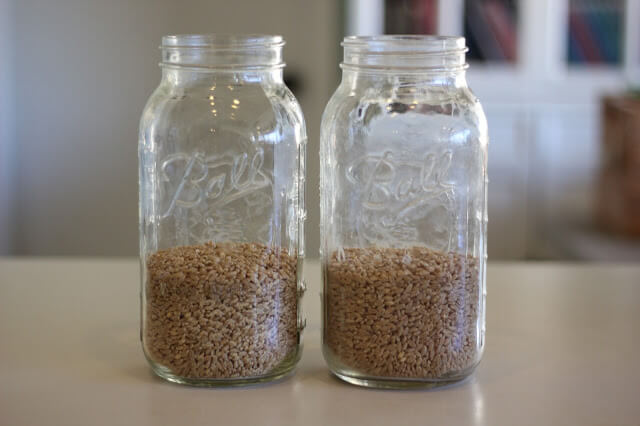
STEP 1: You’ll start by filling two half gallon mason jars (or gallon pickle jars) about 1/3 full.
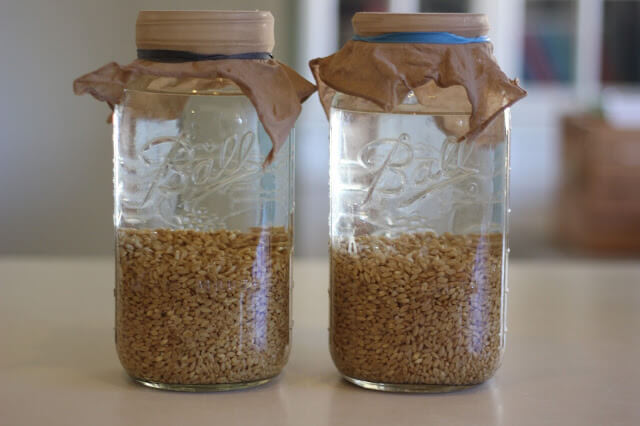
STEP 2: Fill the jars all the way to the top with filtered water. Then cover with some clean pantyhose squares and a big fat rubber band (like the ones from your broccoli). LEAVE OVERNIGHT on your countertop. {In the morning, the wheat will be almost to the TOP!}
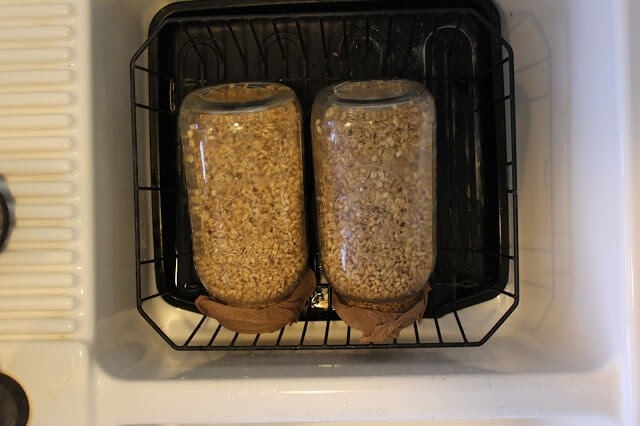
STEP 3: Next day, sometime around noon, dump out the water. Fill up the jars with water again, give it a good rinse, and tip on their sides in the sink to drain.
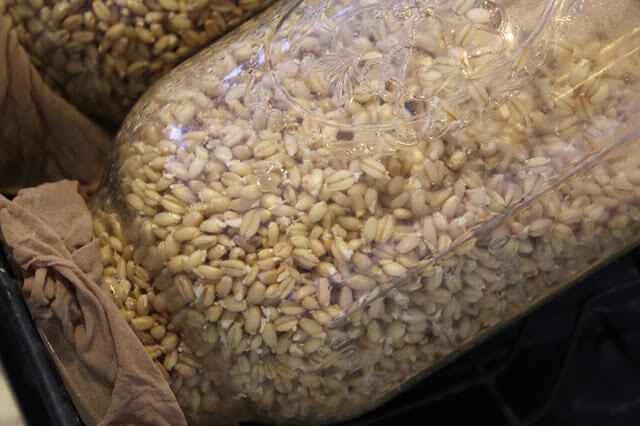
STEP 4: Leave them there until you see little white buds form. This can take anywhere from 6-24 hours depending on the humidity and temperature of your kitchen. You may rinse 1-2 more times during this waiting period if you so choose.
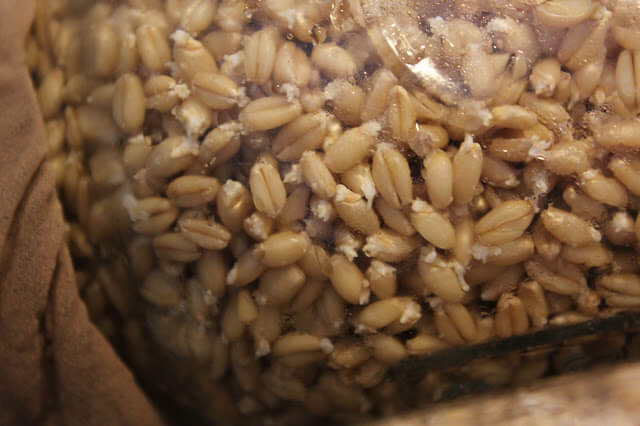
See those little buds? That means the grains were prepared properly and the wheat has finally released the phytic acid.
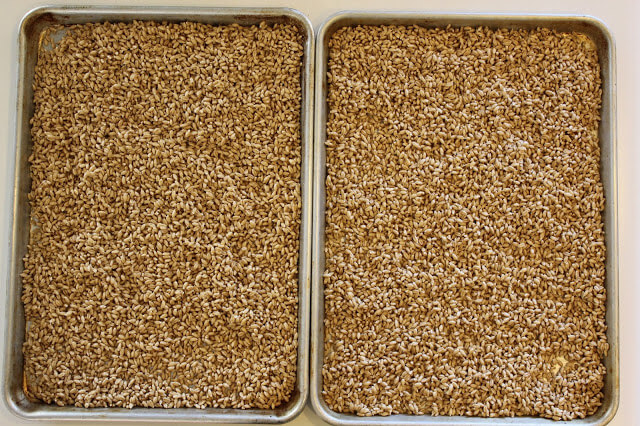
STEP 5: Dump sprouted wheat onto 2 cookie sheets. Bake in oven at lowest temperature (Mine goes to 175 degrees) for 6-8 hours or overnight.
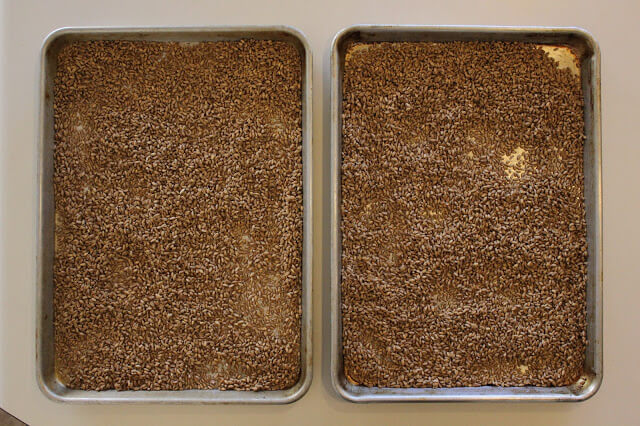
STEP 6: Be really proud of your self and resist the urge to roll around in your treasure.
- Fill a jar 1/3 full and soak for 18 hours.
- Dump out water, fill up again to rinse, & place the jar in the sink, tipped on it’s side for 6-24 hours until buds form. (You can rinse a couple times during this period)
- Once buds form, spread sprouted wheat onto 2 cookie sheets. Bake at lowest temp for 6-8 hours.
- Grind & enjoy!
Frequently asked questions:
Q. That seems like a lot of work!
A. Hey, that wasn’t even a question! Honestly though, it’s really not work, it’s just being patient for a couple days.
Q. That doesn’t seem like very much wheat!
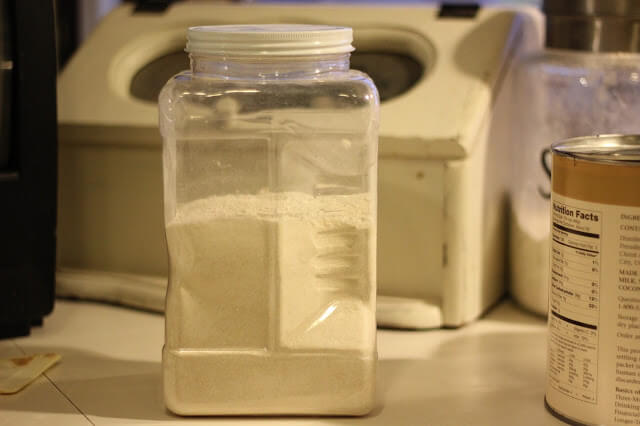
A. Yes, it doesn’t seem like a lot of wheat, but this amount of wheat lasts our family of four 3-4 weeks. (You can also sprout a bigger batch and freeze it) Most Americans eat WAY too much wheat and grains in general. While they are part of a balanced diet, at our house we choose to keep it simple. What you see in that final jar of sprouted wheat flour is what we use to make a cake, or cookies, or tortillas. I don’t use sprouted wheat to make our bread (although it is possible!).
Q. What if I don’t have the time to sprout my own wheat? Can I buy it somewhere?
A. Yes, indeed! The best place to buy sprouted wheat flour is here
So, what do you think of Sprouted Wheat? Will you ever try it? If you’re not convinced yet, just wait, I’m going to post the most amazing chocolate cake ever! Sprouted wheat chocolate cake –that is.

Hey y’all! I was about to buy the sprouted flour on Amazon when I realized it was sold by Vitamin Shoppe. We have a Natural Grocers in town (Missoula, MT) which is/has the Vitamin Shoppe in it, so I called them for the price of their 5 lb bag. They sell sprouted wheat flour for $10.99 and sprouted spelt for $9.99! You can save SO MUCH if you can shop at a local store! ? hugs!
Have you sprouted einkorn berries this way? I’m wondering if it would be done the same way? Thank you!
Hi Billie-
Yes, you can use this method for einkorn.
Thank you -Bobbi (DaNelle’s Assistant)
Here’s why this recipe fails: you can’t dry sprouted grain flour at 175° and expect to bake with it. It becomes malt and has no structure to make bread. You could add a bit of it to bread to get a malt flavor, but you can’t use it as a baking grain alone. Further, at 175° it loses the valuable enzymes you’d benefit from in sprouted grain flours. And yes, unless you have a grain mill or the equivalent it’s hard to grind fine. You need soak the wheat berries for 3-5 hrs, drain and let sprout until the white buds split into two (draining 2x/day, of course). Then dry out on a tray (takes a long time) or dry in a food dehydrator at <113° for ~12hrs. This preserves the enzymes and also has the benefit of requiring a short rise since the phytic acid been eliminated… which is what a long, cold rise does for unsprouted whole grain flours. (Phytic acid is what makes grains 'unhealthy,' although that's a tricky term.)
I, too, was wondering about those high drying temps. Am ready to give the sprouted wheat method a try. Has anyone out there actually gotten good results? I see lots of questions, but no comments about results.
I use a dehydrator on 105-115° for about 12 hours. Has made awesome flour and bread.
Drying the berries at any temp over 150F destroys and goodness (for want of a better word) that you tried to achieve by sprouting them in the first place. For me, the easiest method of drying is simply in the oven with nothing but the light on; mine registers @85F that way and it takes roughly 24 hours to completely dry 2 half sheet trays of berries.
The really time consuming part for me is the grinding as I have to do it in coffee grinder because my food processor does not grind fine enough for my liking. The King Arthur baking website has a few very good sprouted wheat recipes from bread to cookies to cakes.
Interesting point.
Do the enzymes survive the 400 degree bread-baking temperature?
Not being able to bake with it is puzzling to me – I buy sprouted flour at the store and my bread and pizza comes out GREAT. So I was looking to save some money and do the sprouting myself since I buy wheat berries regularly. So what is the difference of making it at home that makes it unusable for bread making??? Does the commercially produced sprouted flour have a different procedure that makes the flour ideal for bread and pizza??? Again I have used commercially produced organic sprouted wheat flour countless times and produced beautifully delicious breads and pizza.
This week I sprouted about 6 cups red winter wheat berries. Dried them at 200F for about 4 hours. Then using my flour mill, I ground the dried berries and sifted with a fine sieve. I ended up with about about 4 cups of flour, the rest was bran that I reserved for muffins. The flour smelled wonderful of malt.
Using it, I made a simple loaf with 400 grams sprouted with flour and 100grams regular bread flour, plus a tablespoon wheat gluten. As soon as I mixed the water with the flour, I could see that there was a problem. The gluten would not develop the dough would not come together. I had disolved the yeast with 20 grams maple syrup, so the yeast was active, but the dough rose much less than 2x. It didn’t rise in the oven and turn out like a lump of coal. Tasted decent, not sure what to do with but feed the birds.
There is a web book published by a university in British Colombia that provides a good deal of guidance, in it it says that malted flours are not recommended to use as a base for bread, rather as an additive to give flavor, color and texture. They recommend between 1 and 9% malt by weight of total flour depending on the type bread.
I found a lot of online shops that sell different wheat varieties of sprouted wheat flour with recipes that call for up to 75% of their sprouted wheat flour. It makes no sense to me, unless the sprouted wheat flour they sell contains a large portion of non-sprouted wheat flout.
See the other comments: drying at high temperatures turns the spouted berries to malt which won’t rise. The commercial sprouted flours and properly homemade ones work great for just about all recipes
Hi Lovely,
Where do you buy the wheat? Do I need to buy the same wheat I buy for my wheatgrass, intended for sprouting (more expensive and organic) or can I buy my usual conventional hard red wheat?
thanks!
Hi Cherie-
Either wheat variety will do. DaNelle gets much of her bulk grains and nuts from Amazon or from the local health food store.
Thank you -Bobbi (DaNelle’s Assistant)
My wheat soaked and plumped just fine. I followed the next step and let it be flipped over and drained as I waited for it to sprout. But it didn’t sprout as much as yours. Some of the ends looked like they opened a bit and there was a LITTLE something poking out the tip. But not as much as yours in the picture. And some berries didn’t look like they sprouted or opened at at all. I waited a full 24 hours before I decided to dry them (because I was worried about them souring). Does it matter that they don’t all open? Is my wheat bad, do you think? Thanks so much!
Hi Alicia-
That’s ok if they didn’t sprout as much, they should be fine. It’s good you didn’t let them go over 24 hours.
Good luck with your flour!
Thank you -Bobbi (DaNelle’s Assistant)
Hi. I’m in between step 1 and 2. I put water with my berries last night at 6pm.. it is now the next day at 10am. There are no changes.
Hi Pam-
If the berries did not plump, and you added enough water to begin with, go ahead and proceed with the recipe. You don’t want to soak them for an addtional night. Some varieties of wheat berries don’t absobred water as well as others. Typically the soft wheat varieties are less absorbant than the hard varieties. I hope that helps. Thank you -Bobbi (DaNelle’s Assistant)
Thanks SO much for these instructions. Have done it and am so excited to have this sprouted wheat at my disposal. Prior to having your instructions I bought sprouted wheat flour at my organic market and made bread with it with great success. I was dismayed when I read that you don’t make bread with yours. After making my first batch from your instructions I made a recipe with buttermilk that was light and tasted like sour dough. I think it makes fabulous bread.
I have a friend who doesn’t bother with drying the sprouted grains in the oven. She puts them in a blender, adds water and blends until they turn into soup and no grains are visible. Then she pours the “soup” into a bowl and adds oat fiber (not oat bran) to it until she gets a dough consistency. Her sprouted grain bread is delicious!
Any chance your friend is willing to share recipe with instructions…this sounds ideal! Thanks muchly!!
Yes, do share! This sounds lovely.
That sounds very interesting! I’d love to get that recipe!
I’m surprised about the comments that sprouted flour doesn’t work for bread making – I was counting on this for that purpose.
I have used commercial organic sprouted flour I bought at the store and my bread and pizza were great.
Sprouting at home yields a different product that can’t be used for breads?
Hi Leslie-
You can used the sprouted flour for bread and pizza dough, it just makes them more dense, coarse, and chewy. If you make some bread or pizza let us know how it goes! Thanks -Bobbi (DaNelle’s Assistant)
When rinsing, must you use filtered water, or will tap water be all right? What about tap water that has been left out to allow any chorine to evaporate? Also, my wheat berries sprouted, but they did not plump up like the ones in your blog photos – that is, I started with about 1/3 jar and ended with a little more than 1/2. Were they supposed to absorb more? Does that have something to do with their age? Or their type (red, white)?
Hi Mark-
Filtered water is best, so you can be sure most of anything unwanted has been removed. You can leave water out, boil it, or add vitamin C to neutralize the chlorine.
As for your wheat berries, typically the only difference in absorption is if it is a hard or soft wheat. The hard variety absorbs water more readily.
I hope this helps! Thanks for reading and posting. -Bobbi (DaNelle’s Assistant)
I’m not sure if this was mentioned, but when I was doing research on this I found that the enzymes will begin to die at temperatures above 115. So the best way to preserve the enzymes and dehydrate the berries is with a food dehydrator at no higher than 115. If an oven is all you have then you have to work with what you have, but the enzymes will die since no oven will go lower than 170 or so. 🙂
Hi CoffeyK-
It’s always important to properly prepare food. So glad you are researching this! Just for clarification, enzymes are not technically alive, but can become activated or deactivated when heat (or pressure) is involved. Too high of heat can indeed deactivate enzymes. Although typically the 115 degrees refers to wet heat such as when heating milk. Dry heat is usually up to 150 degrees, although 185 degrees can be ok too. Although if you have access to a dehydrator I would definitely go with that. I do not have a dehydrator, but I am lucky enough my oven goes as low as 150 degrees (although it is rather ancient…I hate buying new stuff). Thanks so much for reading and posting! -Bobbi (DaNelle’s Assistant)
Excellent information on making sprouted wheat flour.
I used quart jars and followed the same ratios. My wheat was still soaking in the jars, but had pretty much spouted after 12 hours, so I drained it and let it sit in the sink for another 4-6 hours. It’s already sprouted, or at least I think it is. Is it unusual for it to go this quickly or did I rush it?
Totally normal, especially in the summer:)
What is the best wheat berries to buy for sprouting?
Thanks for sharing this post.
We’ve moved to Brazil, and I finally found some whole wheat so I could try this. The sprouting process went fine, but I’ve just attempted the drying. We have a rather finicky oven…sometimes it stays on and sometimes it doesn’t. The lowest temperature is also 350. So I tried to just heat the oven and turn it off, but I couldn’t keep the temp at 180 using a thermometer. So I’d turn the oven on for a few minutes and then off so it would hold at least a little heat…. but I think I ‘cooked’ my wheat berries. The resulting flour smells great, but it’s dark in color. Any chance I can still make bread from this?
Hmm, I’m not sure. I say go for it!
Are you able to grind it enough so it’s soft? I tried it, but no matter how I ground it (blendtec, Norwalk, coffee grinder) it was still gritty. Help!
I was still able to, but you make want to grind it in a grain mill like this one. It’s designed to handle hard grains.
Will a Cuisinart food processor do the job?
Hi Roy-
No, a food processor won’t work because it can only grind wheat berries to a certain extent, and will leave a coarse grain. Plus this can be pretty hard on your food processor and may cause damage.
Thank you -Bobbi (DaNelle’s Assistant)
I did my first batch, and everything went as you specified, after drying it in the oven tho, it was SO hard to grind! I have a hig powered blender, a high powered food processor, etc. I tried them all. When i finally got it ground, it has a brown tinge. Did i dry it too long??
Hi Heather, you make have soaked & sprouted it too long. Reduce that time next time:) Sprouted flour will be a little more coarse than regular flour, but not super crumbly
I can’t find the sprouted wheat chocolate
Cake recipe.
I tried the sprouted wheat brownies and they were the DELICIOUS!!!!
I am also looking for that recipe, I can’t find it on here or on her pinterest page. Help?
Currently DaNelle does not have it made out into a recipe, but here’s one she suggests trying: https://eatrealstaysane.com/healthy-chocolate-cake-with-sprouted-flour/
Let us know how it goes! Best of luck and Happy Baking! Thank you -Bobbi (DaNelle’s Assistant)
I had the opportunity to sprout and dry my wheat berries, but before I had the time to grind it into flour, life got in the way. They have now been sitting fully sprouted and dried in a mason jar on my counter through the summer.. How long could they last like this? Are they still good? They look and smell fine….
Hi Judy, I don’t think they would be good. When you sprout grains, they go bad a lot sooner, so they’d need to be frozen or refrigerated to stay good:)
I have sprouted my own wheat a couple of different times. The first time, I did a small batch and it turned out great. The second time, I did a larger batch and the wheat berries after sprouted had a strong smell to them that then carried over into the flour. Needless to say I tried using it in some baking anyways, and unfortunately it did make the baked goods taste the same way the berries smelled. YUCK! I thought maybe I did too big of a batch and they soaked for too long? I tried it again doing a smaller batch, and thought I watched them closer, but after drying them out in the oven, I smelled the strong smell and failed again. Any suggestions? I think I am going to try another very small batch and pray for success. I’m feeling conquered by real food these days!
My guess would be that the bigger batch allowed bacteria to grow in it, which produced the bad smell:)
Does it matter what kind of wheat or grain you use in the sprouting process?
Not really, though depending on the grain, the soaking time could be different.
Hi there. I was wondering, if when you make this, your wheat gets a funny/sour smell by the end of the process? I have done this twice now, and both times my wheat smells different. I haven’t been too worried about it, but was still curious.
Thanks!
It can smell very lightly sour/sweet, but a strong sour smell means it fermented and I would toss it or feed it to the chickens:) Next time try to leave it in the jars for a shorter amount of time:)
Hi! Love your teaching! I tried this last night. Filled up my jars with some of my organic heirloom wheat at about 11 pm. It’s now 7:30 pm today and my wheat has not doubled? Any ideas? What should I do?
Was there enough water? If it hasn’t doubled, I’m sure it’s close:)
I bought my big jars today and I’m going right now to fill them water and wheat. I’ll let you know tomorrow how it turns out.
I tried it and mine didn’t sprout. I’ve waited a long time. I’m still going to dry it and grind it. I’m sure it will still taste fine. I just wonder why it didn’t sprout.
Yeah, the soaking should have still done the job. When wheat doesn’t sprout, it’s usually that it’s old, or has been applied with pesticides.
Hi THERE,
Now this is a really stupid question but where do I buy the whole wheat? I haven’t seen it anywhere…
Anyone?
Never mind, I just noticed it’s called “wheat berries”…! I should probably know this…how embarrassing…
I do not have a grinder yet, have been researching to find a good manual one that will do both things like flax seeds and beans as well as wheat and the drier grains. Your blog gave me food for thought and I am wondering if you could help me with the issue of grinding sprouted grains? I have heard from many sources and friends who claim that you can not grind sprouted grains (any kind) into flour, no matter how long or what temp you dry it at, as they always stay too gummy, yet you say you have achieved this. Does it not gum up your grinder? Is your grinder electric or manual? Have you ever sprouted barley or other grains and ground them up?
Thanks for taking the time for my questions.
I am drying my second batch of sprouted wheat. The first batch was great, but my bread turning out just a bit gummy. I read that happens when the sprouts get too long. Thanks for the good pictures of the sprouts, so now I know just when to start drying.
I just finished dehydrating my sprouted berries in the oven this morning. I am beyond excited to grind the flour and try making something delicious with it! As others mentioned, it took quite a bit longer for my berries to sprout, but I think that’s because it’s winter and our house is chilly. Thanks so much for the tutorial, DaNelle!
Yes, the winter does slow down the sprouting. I’m excited for you!
ok i spent the last 48 hours soaking and draining and waiting and dryinging in the oven………….just grounded it into flour and will have a few busicuts in the morning……………….staytuned!!!!!!!!!!!!!!
My wheat berries are taking longer to sprout. I started soaking them Thursday, and then have been rinsing them and laying the jars on their sides a few times daily since Friday. I barely see any sprouts. Am I doing something wrong or is there something else I can try?
See Step #4. It depends on the temperature and humidity of the room. During colder weather, sprouting will take longer; in warm weather, less time is needed.
what’s the difference between sprouting and grinding wheat (like this post https://www.weedemandreap.com/2013/01/how-to-make-sprouted-wheat-flour.html) and buying whole wheat flour and soaking it?
Hi! I love your blog BTW, you’re amazing!. Just a quick question, do I have to bake the sprouts a that low temp to dehydrate them? I have left them in the baking sheets (dry) at room temperature for a day or 2 to dehydrate them. But was wondering if there is an specific scientific reason to bake them? or are they to dehydrate them as well? Just wondering :). Hope you can have the chance to reply 🙂
Thanks!
Dehydrating them is fine, but I just use my oven because I don’t have a dehydrator. No particular reason:)
Hi Danelle! What if your oven is small and you can only cook, say, one of those trays at a time? Is it OK to leave the other tray out in the open till the first is done?
Question… Do you used the canned wheat berries from the Church? How old are they? I have some cans of wheat that are 5 years old (ish) and i’m wondering if they will sprout!? I guess I’ll find out!
Question… Do you used the canned wheat berries from the Church? How old are they? I have some cans of wheat that are 5 years old (ish) and i’m wondering if they will sprout!? I guess I’ll find out!
I just found your blog and I’m enjoying it so much! I’ve tried to sprout wheat twice following your instructions, and my wheat will not sprout. A few berries do but the rest do not. Could it be the wheat?
I just purchased a Nutrimill grinder and was really excited to try sprouting. I just read the manual and it says not to use on sprouted grain. 🙁 I am so bummed. Wonder if I could blend it well enough in my Ninja blender?
I wonder why it recommends not using it on sprouted grains… that seems odd. (?) I haven’t done it myself yet (don’t have a grinder and was hesitant to use a blender). Maybe DaNelle can chime in on whether you’d get the same health benefits if you grind first and soak your flour prior to baking.
Hi Mindy, the instructions mean to not put WET sprouted grains in your mill. It is common for people to eat sprouted grains whole and wet, like on a salad or sandwich. You should be fine as long as you are sure the grain is completely dried out before you grind it. You may want to call the company just to be sure!
Does sprouted wheat flour have a different flavor?
Wow, wow, wow!! I have been looking for an easy, step by step way to sprout wheat. THANK YOU!! Going to try soon.
Me too!! You spelled out the process so that it’s very easy to understand! Just what I’ve been looking for.. THANKS! You have so many great blog posts… I’m glad I ran across your blog. My husband and I have been attempting to eat a more traditional diet for about a year now but I have yet to sprout my own wheat or ferment veggies or make my own yogurt. I plan on doing all of these very soon and you’ve re-inspired me. I have, however, made sprouted raw organic hummus that turned out pretty well.. second try coming up! Check my blog for the recipe once I get it “perfected”. 🙂
I’m on my second batch! Yay! If you use a blender, do tiny batches, because the motor will burn out as the wheat gets finer and settles into the bottom. Mine started smelling hot so I stopped. Going to borrow my mom’s grinder. So I have one batch partially ground and another in the oven.
Excited to see if I feel less bloated after I use this for a while.
Ok, it’s me again. I’m just really enjoying your blog! So is that hard red or white that you are using? Have you used the Einkorn?
Thanks, Sue
I am using Spring White Wheat. It’s a Whole-wheat, hybrid but not GMO. I haven’t used Einkorn yet, but I really want to I hear it’s fabulous!
Hi DaNelle, I’ve read elsewhere that drying sprouted wheat in the oven kills all the benefits and it should only be done in a dehydrator. I’m not about to buy a dehydrator so I was really glad to see your simple tutorial! What are your thoughts on the ‘too high’ issue?
Thanks so much : )
If you’re going to bake with the sprouted flour anyway, it shouldn’t matter at what temperature you are drying it at. Some recipes for sprouted grains, beans, seeds, etc. will recommend drying at a low temperature in the dehydrator but this is because they plan on eating the finished product raw, like on a salad.
So, it really depends on what your purpose for the sprouted product is. I hope that helps!
I don’t have a grinder, just a food processor and a blender. Which one do you think would work best for grinding sprouted wheat? Also, do you recommend soaking flour overnight before making bread with a sourdough starter or does the starter break down the flour just as much? Thanks!
I think the blender would work better. When using a sourdough starter, it will break down the phytic acid for you 🙂
DaNelle,
I’ve made 2 batches of sprouted wheat flour, and found that it does not make good bread. I did try tortillas and that seemed okay. Do you think sprouted wheat flour does better in things that require no yeast? My next project is to try the soaking method for bread. Also, I’ve read some things about how long the sprout should be for it to actually be beneficial, have you researched anything like that? Just wondering what your thoughts are on that, because I’ve only come across one article about it.
In my experience, it does do better in things that do not require yeast. I haven’t researched how long soaking is best, I just do it until it starts to sprout. Sprouted wheat makes great cake, cookies & crackers!
And good pancakes. 🙂
What exactly is wheat in the raw form called when I go to the store and ask for it? Is it buckwheat?
Wheat in it’s basic form is called Wheat Berries. When you grind the wheat berries, you make wheat flour. Buckwheat is an entirely different grain, and in fact, although it has the name wheat in it, it’s like wheat at all. Buckwheat is a non-gluten grain.
The first time I tried making sprouted wheat, I used my oven at the very lowest warm setting, which is supposedly 150. My flour didn’t work for anything it was like clumpy cookie dough when I tried to make a bread dough and didn’t rise at all. I think I had successfully cooked my sprouted wheat kernels and that my oven is in fact much hotter than 150. Since that time I have successfully used a dehydrator ($10 at DI!) and the flour turned out great. So just a word of caution to others trying it for the first time. Temp your oven first at its lowest setting before using it as a dehydrator.
I love your idea to only use your sprouted flour for small stuff and do a sourdough for making bread. Its such a sinking feeling to see ALL the flour you just carefully tended for days go into 1 or 2 loaves of bread. Its really not a ton of work, but it seems like it.
Thanks for the tip!! Mine hasn’t burned yet at 175, but this will make me watch it closer!
Someday I will be as cool as you DaNelle! Seriously, I will. I’ve wanted to try this for a while. So doing it tomorrow.
Do it! It’s really more easy than you think!
If I have a regular old blender, not a vitamix, would that do the job of grinding it well enough? If not, where can I get a grinder flour mill – is it worth the investment? Thanks!
I think sprouted wheat would be easier to blend in a regular blender than plain wheat, but I can’t be sure because I haven’t tried it. I definitely think a grinder is worth the investment!
Thank you for the awesome instructions!
I tried to make sprouted flour one time, but it didn’t grind up very well in our wheat grinder and it made all my baked goods super thick and dense. Is sprouted flour more dense like that?
Thank you! 🙂
Make sure it’s completely dry before you try to grind it. I didn’t notice a denser consistency, but wheat in general does that, maybe I can’t notice a difference because I’ve been eating wheat for so long.
I’m going to try this. I’m really enjoying your posts. Thanks for sharing.
where do you buy wheat in bulk like that?
I buy my wheat from my church. I am a Mormon and we have locations all over the US that provide basic staples of food in bulk. They are open to anybody (Mormon or not) and you can search for one close to you on this website…https://providentliving.org/self-reliance/food-storage/home-storage-center-locations-map?lang=eng
I would also recommend purchasing Einkorn wheat online. Einkorn wheat is an heirloom version and this company sells it organic. https://jovialfoods.com/blog/2012/12/wheatberry-packaging/
The one that you buy from your church … is it SOFT white or HARD white? Or does it matter?
The one that you buy from your church … is it SOFT white or HARD white? Or does it matter?
thanks so much for this!! great instructions. will try….some time in the future 🙂